Fruit enzyme face polish: is it safe for acne-prone skin?
Fruit enzyme polishes are often grouped with physical scrubs, as if both exfoliate by doing the same thing more gently. They do not.
Jude Carstairs·Updated: September 23, 2026·10 min read
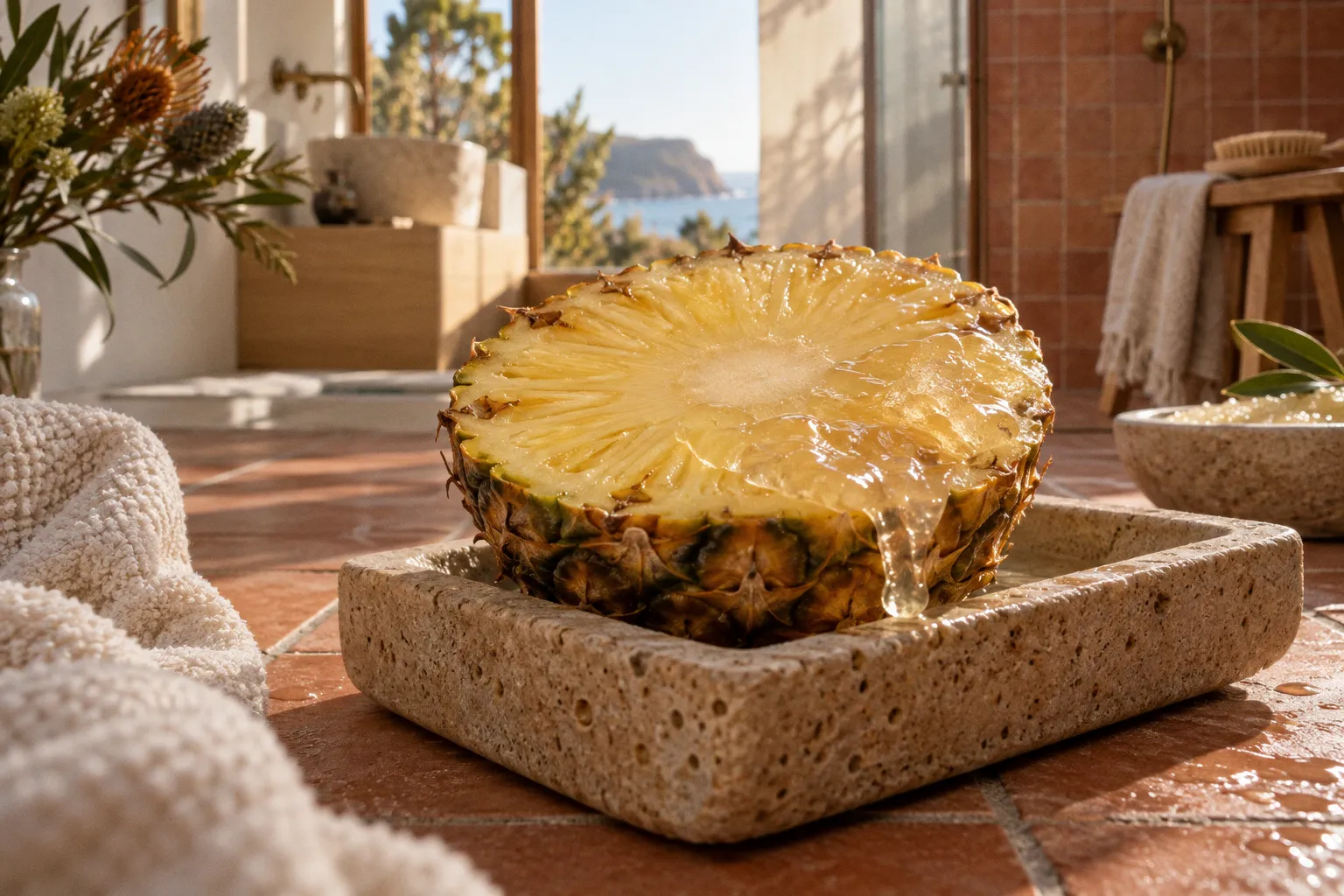
Papain from papaya and bromelain from pineapple are proteolytic enzymes: under suitable conditions, they break down proteins at the skin’s surface. A scrub relies on friction. For acne-prone skin, that difference matters—but it does not make every enzyme polish automatically safe, effective, or suitable for an active breakout.
The useful question is not whether a product feels gentle. It is what the formula contains, how it is used, and how your skin responds. Enzymes can offer a way to exfoliate without abrasive particles, but the evidence does not justify treating a fruit extract as an acne treatment or assuming that a particular pH guarantees results. The label and the whole formula matter more than the word “enzyme.”
The Science of Proteolytic Exfoliation: How Enzymes Digest Keratin
Papain and bromelain are proteases: enzymes that act on proteins. In an exfoliating product, their intended role is to loosen some of the protein connections that help hold dead cells together at the skin’s surface. As those cells shed, the surface may feel smoother. This is a chemical process rather than the scraping action of an abrasive particle.
That distinction is relevant when skin is prone to inflamed spots. A grainy scrub applies friction across the face, including over tender or raised lesions. An enzyme product does not need that rubbing action to work. But the word “enzymatic” is not a promise of zero irritation. A formula can still sting, cause redness, or be a poor fit for a particular person, especially if the skin barrier is already irritated by acne treatments, over-cleansing, or frequent exfoliation.
Enzymes also depend on their conditions. Their activity varies with the enzyme itself and with the formulation around it. A pH around 4.5–6.5 is commonly discussed as a favorable activity range for papain and bromelain; it is best understood as a formulation guideline, not a hard boundary between working and inactive. Activity can be affected by processing, storage, stabilization, and contact time as well. A fruit extract on an ingredient list does not establish how much active enzyme remains in the finished product.
This is one reason to be cautious about neat comparisons with acids. AHAs and BHAs exfoliate through their own chemistry, and their performance depends on factors such as the acid, its concentration, formulation pH, and how the product is used. It is not accurate to describe all acid exfoliation as dissolving the skin’s intercellular lipids. Nor should enzyme products be treated as universally gentler simply because their mechanism is different. The practical comparison is between specific formulas, not broad ingredient families.
Enzymes and scrubs do not exfoliate in the same way. Less friction can be useful for breakout-prone skin, but it is not a guarantee of comfort.
Enzymes vs. Physical Scrubs: Why Friction Aggravates Breakouts
A physical scrub uses particles and rubbing to remove surface cells. The particles might be finely milled, smooth, or irregular; what matters in use is the friction they create and how much pressure the person applies. On skin with inflamed acne, vigorous rubbing can aggravate tenderness and redness. Scrubbing over a pustule may also break its surface, making the area more irritated and harder to care for.
That does not mean every physical exfoliant inevitably causes micro-tears or spreads acne bacteria. Those outcomes depend on the product and the way it is used, and acne is not simply a matter of bacteria being smeared from one spot to another. Still, when lesions are inflamed or painful, adding friction offers little advantage. It can make an already reactive routine feel harsher, particularly alongside leave-on treatments that dry or irritate the skin.
An enzyme polish avoids the abrasive step if it is applied and rinsed off without scrubbing. That is the clearest practical difference. The product still needs to suit the skin: a clay-heavy mask may feel drying, fragrance or other ingredients may irritate, and a product used too often can contribute to discomfort even without particles.
| Parameter | Physical scrub | Fruit enzyme polish |
|---|---|---|
| Main exfoliating action | Friction from particles and rubbing | Enzymatic activity on surface proteins |
| Use on tender, inflamed lesions | Rubbing may aggravate discomfort or damage a spot | Avoid rubbing; suitability depends on the formula and skin response |
| What determines the experience | Particle texture, pressure, frequency, and base | Enzyme, formulation, contact time, and frequency |
| What the label can tell you | Whether the product contains abrasive particles | Whether papain or bromelain is specified; not necessarily how active the finished formula is |
| A reasonable caution | Do not scrub over inflamed acne | Do not assume “fruit enzyme” means irritation-free |
For someone who likes the smoothness of exfoliation but finds grainy products uncomfortable, an enzyme polish may be worth considering. It is not a required step in acne care, and it does not replace treatments designed to address acne. If using one, applying it gently and following the product’s rinse-off directions is more sensible than massaging it in to chase a stronger effect.
Antimicrobial Potential of Bromelain and Papain in Acne Management
Acne involves several interacting factors, including clogged follicles, inflammation, and the activity of Cutibacterium acnes within the pilosebaceous unit. An exfoliant that loosens surface cells may contribute to a smoother-feeling surface, but that alone does not make it a complete acne treatment.
Bromelain has been studied for biological effects that include antimicrobial and anti-inflammatory activity in laboratory settings. Such findings can be interesting when considering why an ingredient is used, but results in vitro do not show that a rinse-off face polish will treat acne in people. The enzyme has to remain active in the finished formula, reach the relevant site, and have enough contact time to matter. A wash-off cosmetic cannot be assumed to deliver those conditions simply because bromelain appears on the label.
Papain is also used for its protein-digesting properties. Its role in an enzyme polish is generally framed around exfoliation rather than a proven direct effect on acne-causing bacteria. Neither papain nor bromelain should be treated as a substitute for established acne care. If breakouts are persistent, painful, or leaving marks, a clinician can help identify treatments suited to the type and severity of acne.
For a routine, the more modest claim is the more useful one: an enzyme polish may provide surface exfoliation without abrasive particles. Whether that makes it a good choice depends on the formula and whether your skin tolerates it. Adding an enzyme product on top of several active treatments can be counterproductive; more exfoliation is not necessarily better exfoliation.
Formulation Standards: Identifying Effective Concentrations and pH Balance
A label that says “papaya extract” or “pineapple extract” does not reveal the amount of active protease in the finished product. The ingredient may be present as part of a broader extract, and manufacturing and storage can influence enzyme activity. Without a disclosed active-enzyme concentration or product-specific stability information, a shopper usually cannot infer potency from the ingredient list alone.
The often-cited pH range of about 4.5–6.5 is a useful activity guideline for papain and bromelain, not a universal pass-or-fail test. A formula outside that range is not automatically inert; neither does a formula within it guarantee meaningful exfoliation. Enzyme type, processing, stabilization, packaging, and use all matter. Claims that all products above a certain pH have denatured enzymes go further than the available information supports.
A few details can still help make a more informed choice:
- A named enzyme is more informative than a vague fruit claim. Papain and bromelain identify particular enzymes; “fruit complex” does not tell you which protease, if any, is present.
- Clear directions matter. A product intended to be rinsed off should be used as directed, rather than left on longer in the hope of increasing its effect.
- The base deserves attention. Clay, humectants, oils, fragrance, and other ingredients shape how a polish feels and whether it agrees with your skin. No single carrier is guaranteed to be non-comedogenic for everyone.
- Do not read potency into ingredient order. Ingredient lists provide useful information, but they do not necessarily disclose the concentration of an active enzyme or its activity after manufacturing.
- Treat frequency as part of the formula. Even a product marketed as gentle can be too much when used often or combined with other exfoliants.
Terms such as “non-comedogenic enzyme exfoliator” can sound more conclusive than they are. Non-comedogenic claims do not guarantee that a product will suit every acne-prone person. The full formula, the individual’s response, and the rest of the routine all count. If a product leaves skin tight, increasingly red, or stinging, those are reasons to stop or reduce use—not signs that exfoliation is working.
Navigating Allergen Risks and Ingredient Transparency in Enzyme Polishes
“Natural” does not mean allergy-free. Papain is derived from papaya, and people with relevant papaya sensitivity should approach papain-containing products cautiously. Latex-fruit cross-reactivity is also a concern for some people with latex allergy, although a cosmetic product’s risk for an individual cannot be determined from the ingredient name alone. Bromelain comes from pineapple and may be unsuitable for someone with pineapple sensitivity. If you have a known allergy, do not rely on a patch test to override medical advice; ask a clinician or pharmacist whether the ingredient is appropriate for you.
For people without known sensitivities, irritation is still possible. A patch test can be a cautious first step for a new product, but it cannot guarantee that repeated use on the face will be comfortable. Avoid applying a polish to broken skin, and be especially conservative if your barrier is already compromised or you are adjusting to prescription acne treatment.
Ingredient transparency has limits. An ingredient list may identify papaya or pineapple derivatives without specifying the active enzyme level, the final pH, or how much activity remains by the time the product is used. That makes it difficult to compare enzyme polishes by potency alone. If those details matter to you, the manufacturer is the most direct place to ask; an ingredient list cannot answer questions it was not designed to answer.
The same restraint applies to claims about pores. Fruit enzymes may loosen surface buildup, but that is not the same as reaching into a clogged follicle and clearing it. For a persistent pattern of blackheads, whiteheads, or inflamed spots, a product chosen specifically for acne may be more appropriate than relying on a polish.
Choosing a Place for Enzymes in an Acne Routine
If you decide to try an enzyme polish, make it a small experiment rather than a new routine centerpiece. Start when your skin is relatively settled, follow the directions, and do not use it on the same day as other exfoliating products until you know how your skin responds. There is no need to scrub while applying it. Rinse gently, then return to a straightforward routine that supports the skin barrier.
The answer to whether fruit enzyme face polish is safe for acne-prone skin is therefore conditional. It can be a reasonable alternative to a gritty scrub for someone who wants occasional surface exfoliation, provided the formula is tolerated and used without friction. It is not automatically safe on active, inflamed lesions, and it is not an acne treatment just because bromelain or papain has interesting laboratory properties.
A good product claim should leave room for that distinction. Enzymes offer a different mechanism from physical scrubs, and that difference can be useful. But the pH range is guidance rather than a hard threshold, the ingredient list cannot prove activity, and skin response remains the test that matters most.