Clean Moisturizers: What to Check on the Label
For anyone navigating acne-prone skin while reaching for plant-led skincare, the immediate paradox is a familiar one: a moisturizer labelled "clean" can quietly congest the follicular pathway while its front-label promises the opposite.
Iris Ellingham·Updated: September 06, 2026·10 min read
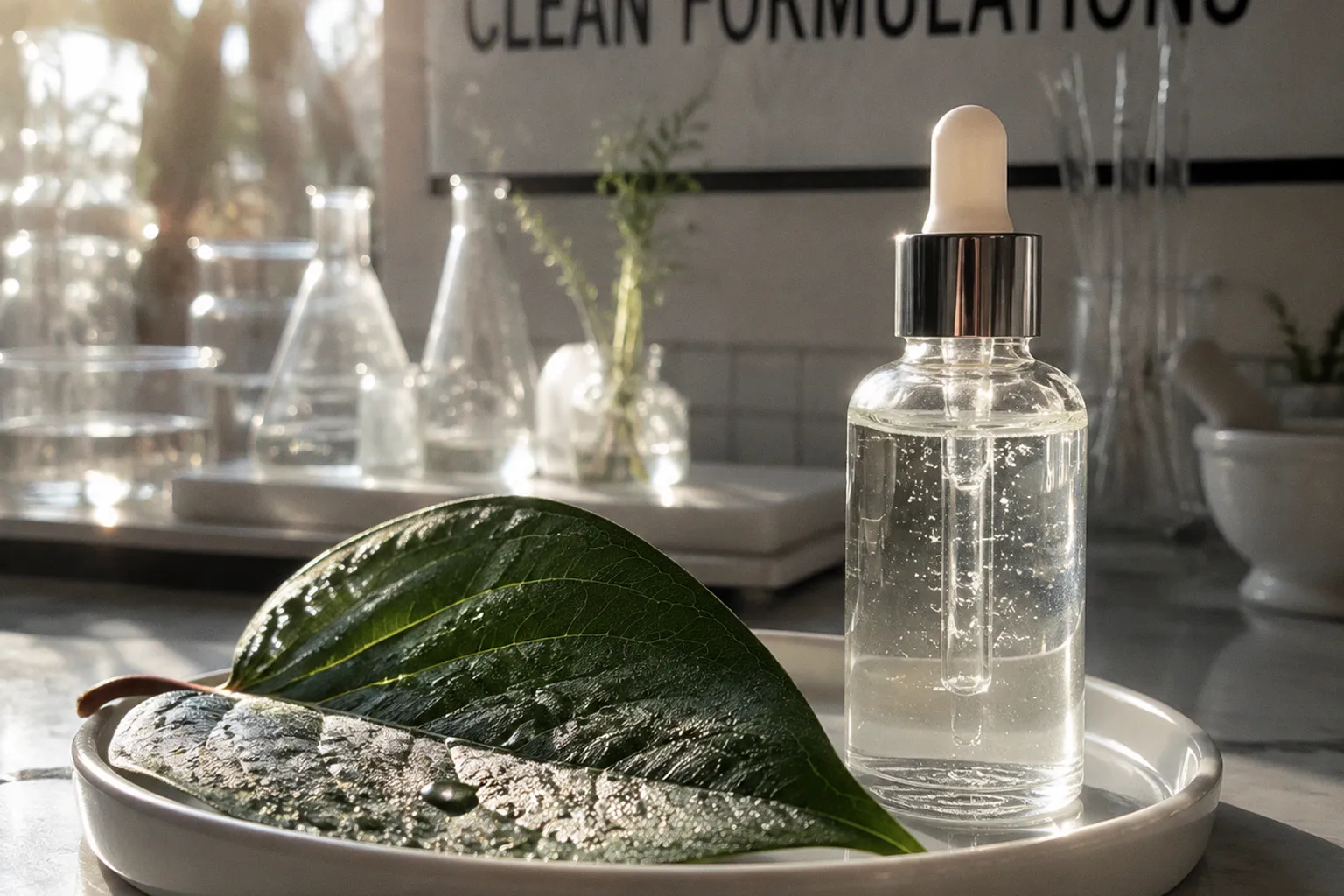
The most reassuring claim on the shelf is often the least informative. Squalane, hydrogenated from olives or sugarcane and rated 0 to 1 on the comedogenic scale, offers what heavier botanical oils cannot — the emollience of a plant lipid without the oxidative baggage that drives follicular inflammation in many complexions. Understanding why that distinction matters requires reading past the marketing language and into the INCI list, where the actual conversation about the skin takes place.
This is where botanical literacy becomes practical. Acne-prone skin is not a single condition; it is a dynamic interplay between sebum composition, barrier integrity, the skin microbiome, and the oxidative stress that amplifies inflammatory cascades. A clean moisturizer that supports one complexion can quietly undermine another, not because the brand has done anything wrong, but because "clean" is not a regulated cosmetic category. It is a values statement — and values do not predict comedogenicity.
A label can read "non-comedogenic" without ever having been tested against a single follicle.
The Myth of the Non-Comedogenic Label
The phrase "non-comedogenic" carries the gravitational pull of a regulated medical term, but it is neither defined nor enforced by the FDA, the TGA, or any equivalent cosmetic authority. Any brand may apply it to a product without submitting a comedogenicity study, without referencing a standardized methodology, and without disclosing the threshold it considers non-clogging. This is the first thing worth holding in mind when scanning a label: the word itself is a promise, not a certification.
The historical origin of comedogenicity testing explains why the rating system feels authoritative in the first place. Through the 1970s and 1980s, researchers developed the now-familiar 0-to-5 scale by applying individual ingredients to rabbit ears and observing follicular responses. The scale survived long after the methodology was largely replaced by human patch testing and, more recently, by in vitro models — yet the ratings still circulate on ingredient databases, blog posts, and brand glossaries as if they were settled science. They are useful guides, but only when their limitations are honoured.
The practical consequence is straightforward: a moisturizer that markets itself as non-comedogenic may still contain ingredients rated 3 or higher on the comedogenic scale. The front-label assurance and the back-label reality can diverge entirely. For someone prone to inflammatory acne — the papules, pustules, and under-the-skin nodules that resist topical treatment — this gap is not a footnote. It is the difference between a barrier-supportive ritual and a cycle of clogged pores that quietly worsens with every application.
Decoding the Comedogenic Scale: Reading Between the Ratings
The 0-to-5 comedogenic scale assigns each ingredient a numerical estimate of its likelihood to clog pores. Zero indicates a low probability of follicular congestion; five signals a high one. Most dermatological guides, including those consulted by clean beauty formulators, treat a rating of three or higher as the threshold above which an ingredient warrants caution on acne-prone skin.
This is the scale worth keeping beside the magnifying glass when reading an INCI list:
| Rating | Interpretation | Acne-Prone Consideration |
|---|---|---|
| 0 | Non-comedogenic | Generally safe for most complexions prone to breakouts |
| 1 | Very low risk | Well tolerated by the majority of acne-prone users |
| 2 | Low to moderate | Use with awareness; depends on concentration and overall formula |
| 3 | Moderate to high | Considered a threshold risk; evaluate in context |
| 4 | High | Frequently flagged as an acne trigger |
| 5 | Very high | Strong association with follicular congestion |
Ratings of 0 to 1 are typically the safest territory for plant-led moisturizers intended for congested complexions. Glycerin, biofermented hyaluronic acid, panthenol, niacinamide, and most ceramides fall comfortably into this range, which is why they appear across nearly every dermatologist-recommended clean formula. Squalane, derived from olives or sugarcane, also sits at 0 to 1, despite being a lipid — a category often reflexively avoided by those with oily or acne-prone skin.
Ratings of 2 introduce nuance. Rosehip oil at 1 is generally well tolerated; it is one of the botanical oils most consistently praised for its fatty acid profile and its retinoid-like behaviour on post-inflammatory marks. But rosehip on its own, combined with a richer carrier or a heavier occlusive, can shift the overall formula's behaviour. This is the second principle worth internalizing: comedogenicity is not a property of an isolated ingredient alone. It is an emergent quality of the finished product.
Ratings of 3 and above deserve scrutiny. This is where unrefined coconut oil — widely beloved in natural skincare circles — lands. Its rating of 4 places it firmly in the high-risk category, and dermatologists consistently flag it as an acne trigger when used on facial skin. The lauric acid that gives coconut oil its antimicrobial reputation is the same fatty acid profile that, in many users, drives follicular inflammation. The presence of coconut oil high on the INCI list of a "clean" moisturizer is a signal to slow down and reread the rest of the formula.
Hidden Triggers: When Safe Ingredients Become Comedogenic in Combination
A single ingredient's rating can mislead in another direction too: when benign compounds combine into a finished formula, the result can behave quite differently from any of its parts. The most commonly cited example in clean cosmetic chemistry involves cetearyl alcohol.
On its own, cetearyl alcohol is generally considered non-comedogenic. It is a fatty alcohol used to stabilize emulsions, giving creams their silky glide and helping active ingredients disperse evenly across the skin. Many plant-led formulas rely on it for texture. The complication arises when cetearyl alcohol is paired with ceteareth-20 — an ethoxylated emulsifier that allows water and oil phases to merge into a stable cream. Together, this combination is reported as comedogenic, even though neither ingredient alone triggers that concern.
The mechanism is not mysterious. Ceteareth-20 is a surfactant, and certain surfactants can disrupt the lipid organization at the follicular opening, allowing heavier components of the formula to penetrate and accumulate in the pore. Cetearyl alcohol, normally a benign texture agent, becomes a participant in that disruption. The INCI list will show both ingredients, often listed near the middle of the formula. They look harmless in isolation. In combination, they are a known acne trigger for sensitive complexions.
This is why reading an INCI list line by line is not sufficient. The cleaner approach is to look for clusters — surfactants paired with fatty alcohols, esters paired with heavy plant butters, silicones paired with occlusive polymers — and to treat those combinations as a single, integrated signal rather than a collection of independent choices. A formula with five individually low-rated ingredients can still behave like a comedogenic product when those ingredients are formulated without attention to the interaction between them.
An INCI list is a conversation between ingredients, not a roll call of independent facts.
Botanical Balancing: Why Squalane and Rosehip Outperform Heavier Oils
The instinct to avoid oils entirely is understandable but pharmacologically incomplete. The skin's own sebum contains roughly 10 to 12 percent squalene, a naturally occurring lipid that contributes to the flexibility and permeability of the lipid barrier. Squalene, however, is unstable: it oxidizes rapidly when exposed to air, and oxidized squalene is one of the documented contributors to follicular inflammation in acne-prone skin.
Clean cosmetic chemists have solved this with squalane — the hydrogenated, shelf-stable sibling of squalene. Because squalane is fully saturated, it resists oxidation. It mimics the skin's own squalene closely enough to integrate into the lipid matrix without disrupting it, and it carries a comedogenic rating of 0 to 1. For acne-prone complexions, it offers what heavier botanical oils cannot: the slip and emollience of a plant lipid without the oxidative baggage.
Rosehip oil occupies a similar niche at a slightly different altitude on the rating scale. Its rating of 1 places it in the very-low-risk category, and its fatty acid profile is unusually rich in linoleic acid — a fatty acid that research suggests is often underrepresented in the sebum of acne-prone individuals. Supplementing the skin's surface with linoleic-acid-dominant oils has been associated with improvements in barrier function and reductions in follicular congestion. Rosehip also contains natural retinoid precursors and a phenolic acid profile that contributes gentle antioxidant activity without the irritation risk commonly associated with synthetic retinoids.
By contrast, oils high in oleic acid — including olive oil, avocado oil, and several heavy butters — tend to disrupt the lamellar structure of the stratum corneum more aggressively. They sit closer to the 2-to-3 range on the comedogenic scale, depending on refinement and source, and they can feel luxurious on dry or mature skin while quietly congesting the pores of someone prone to breakouts. The botanical balancing act in clean formulation is, in large part, an act of selecting lipids that reinforce barrier function rather than overwhelm it.
Building a Barrier-Supportive Routine with Clean Humectants
Beyond lipids, the humectant and barrier-repair components of a clean moisturizer deserve equal attention. Humectants attract water into the stratum corneum; barrier-repair ingredients help the skin retain that water and rebuild the lipid matrix that acne-prone skin often compromises through over-cleansing, exfoliation, or environmental oxidative stress.
Glycerin remains the most dependable humectant in clean formulations. It is well tolerated across nearly every skin profile, costs little to source responsibly, and integrates into both water-based serums and oil-based creams without destabilizing either phase. Biofermented hyaluronic acid — produced through bacterial fermentation rather than animal sources — has become a standard companion to glycerin, functioning as a humectant that helps the skin's surface retain moisture. Its effect can vary with molecular weight; high-molecular-weight forms tend to remain near the skin's surface, providing hydration and a smoothing effect, while lower-molecular-weight forms may offer slightly different textural benefits. Together, they form the hydration backbone of most barrier-friendly formulas.
Niacinamide, a form of vitamin B3, plays a different role. At commonly studied concentrations in cosmetic formulations, it supports ceramide synthesis, calms inflammatory signalling, and helps moderate sebum oxidation. It is one of the rare cosmetic actives that addresses multiple acne-related pathways simultaneously: reducing the appearance of post-inflammatory marks, supporting the barrier, and contributing to a more balanced lipid profile at the follicular opening. Clean formulations that include niacinamide high on the INCI list — rather than buried as a marketing afterthought — tend to deliver more reliable results for congested complexions.
Panthenol, also known as provitamin B5, contributes humectant behaviour alongside a soothing, reparative quality that makes it valuable during the early stages of a retinization process or after exfoliation. Ceramides — the lipid molecules that constitute the mortar between the skin's protein bricks — round out the list. A clean moisturizer that includes ceramide NP, ceramide AP, or ceramide EOP alongside cholesterol and fatty acids in appropriate ratios mimics the skin's native barrier chemistry rather than simply sitting on top of it.
The practical takeaway is layered. Look for glycerin, biofermented hyaluronic acid, niacinamide, panthenol, and ceramides high on the INCI list — ideally within the first ten ingredients, where concentrations matter most. Look for squalane and rosehip oil as the lipid backbone. Treat any mention of unrefined coconut oil, heavy butters, or the cetearyl-alcohol-plus-ceteareth-20 pairing as a reason to slow down and reconsider. And remember that the words on the front of the bottle, however reassuring, are not the conversation that determines whether a moisturizer will support the barrier or quietly congest the pores.
The cleanest formula is the one whose INCI list you can read with fluency, ingredient by ingredient.