Kakadu Plum: Why Native Vitamin C Works on Acne Marks
Kakadu plum contains approximately 2,300–3,150 mg of vitamin C per 100 g of fruit, with some measurements reaching 3,600 mg. Oranges contain roughly 30–50 mg per 100 g. This difference explains the ingredient’s position in Australian botanical skincare.
Jude Carstairs·Updated: September 04, 2026·15 min read
It does not, by itself, prove that a Kakadu plum serum will outperform every synthetic vitamin C formula.
The relevant question is narrower: why does Kakadu plum vitamin C work on acne marks? The answer involves melanin synthesis, oxidative stress, polyphenols, and formulation quality. The fruit’s vitamin C content is only the starting point. The final effect depends on how the extract is processed, standardized, preserved, and delivered to the skin.
Acne marks are usually post-inflammatory hyperpigmentation, or PIH. They are not the same as atrophic scars, rolling scars, boxcar scars, or ice-pick scars. A topical botanical can influence excess pigment. It cannot rebuild tissue lost during inflammatory acne.
The science of nature’s richest vitamin C source
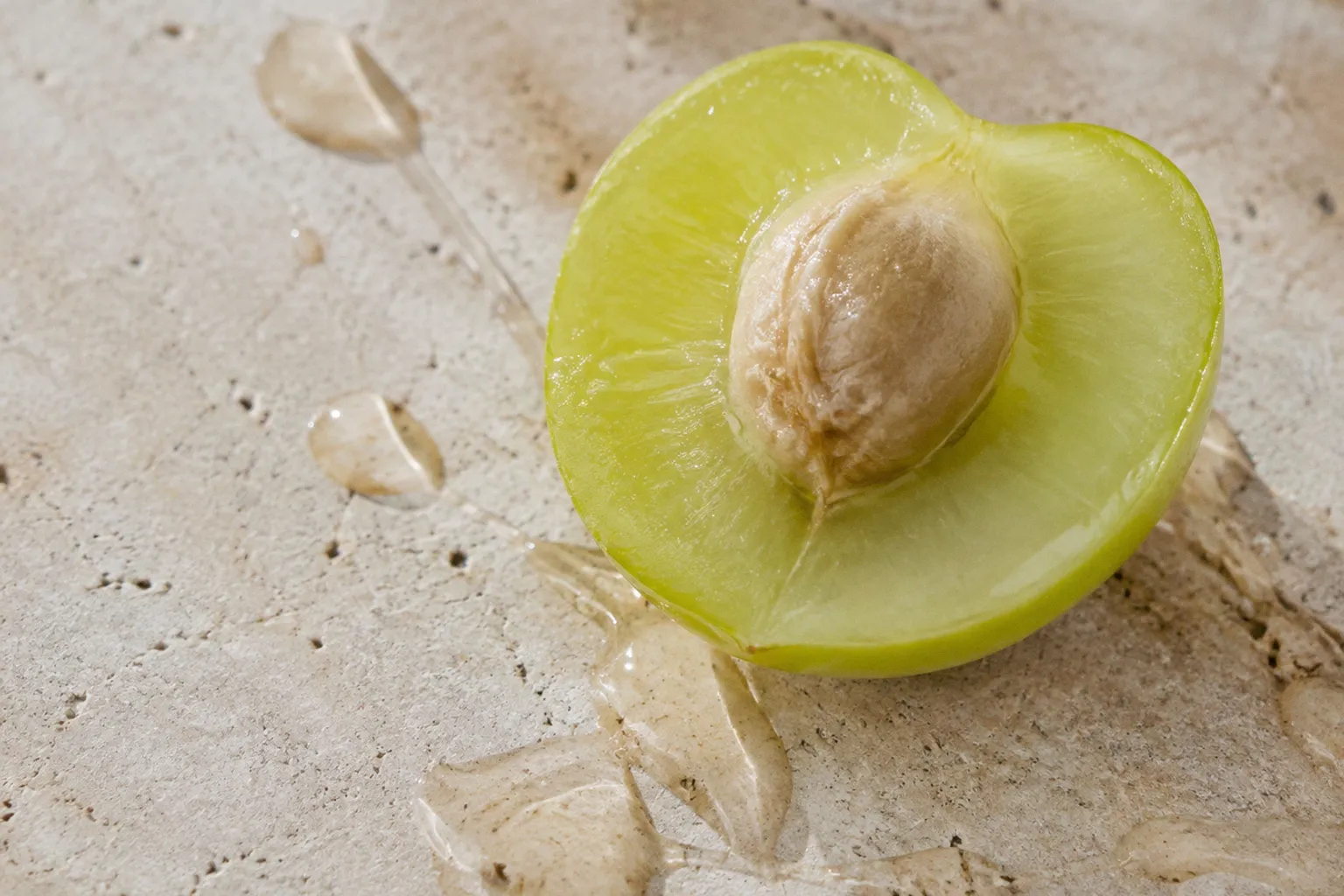
Kakadu plum is the fruit of Terminalia ferdinandiana, an Australian native species. It is also known as Gubinge, Billygoat Plum, Murunga, and Anmarlak. Its unusually high ascorbic acid content is the main reason it appears in brightening serums, masks, and other A-beauty formulations.
Vitamin C has several relevant functions in skin. For post-acne marks, the most important is its influence on melanogenesis, the biological process that produces melanin. It also contributes antioxidant activity, which is relevant because inflammation and oxidative stress can sustain uneven pigmentation after a blemish has healed.
The comparison with oranges is useful but easy to misuse:
| Parameter | Kakadu plum | Orange |
|---|---|---|
| Vitamin C in fruit | Approximately 2,300–3,150 mg per 100 g; some measurements reach 3,600 mg | Approximately 30–50 mg per 100 g |
| Botanical origin | Australian native fruit from Terminalia ferdinandiana | Cultivated citrus fruit |
| Relevance to skincare | High natural vitamin C content plus polyphenols | Vitamin C source, but not a direct indicator of topical performance |
| What the comparison does not establish | That a finished serum contains equivalent vitamin C or has superior clinical efficacy | That lower fruit content makes a topical formula ineffective |
The concentration in the raw fruit is not the concentration applied to the face. Extraction introduces variables. Water content, drying method, solvent system, storage, oxygen exposure, and preservation all alter the amount of active material that remains available in the finished product.
This is the first distinction between a credible formula and a botanical marketing claim:
- Fruit composition describes the plant material.
- Extract concentration describes how much botanical extract enters the formula.
- Vitamin C concentration describes the amount of ascorbic acid or vitamin C derivative present.
- Skin delivery describes how much of that material remains stable and reaches the relevant epidermal structures.
These values are related. They are not interchangeable.
A fruit can be exceptionally rich in vitamin C while a poorly standardized serum delivers very little active material to the skin.
The term “natural vitamin C” also needs precision. Kakadu plum may provide naturally occurring ascorbic acid and associated plant compounds. It does not automatically provide a chemically superior form of vitamin C. The performance of any vitamin C ingredient is controlled by concentration, pH, oxidation, packaging, and exposure to light and air.
Inhibiting tyrosinase: how Kakadu plum targets dark spots
Tyrosinase is a key enzyme in melanin production. It catalyses steps involved in the conversion of tyrosine into melanin precursors. When inflammatory acne activates pigment production, tyrosinase becomes one of the relevant biochemical targets.
Kakadu plum can help reduce the appearance of post-acne dark spots by inhibiting tyrosinase activity. This does not bleach the skin. It reduces one pathway involved in excess melanin synthesis, allowing the pigmented cells in the upper epidermis to be shed over time.
The mechanism can be understood in four stages:
1. Inflammation alters melanocyte activity.
Acne-related inflammation releases signalling molecules and increases local oxidative stress. In some skin types, melanocytes respond by producing more melanin than is needed for normal photoprotection.
2. Melanin accumulates in the epidermis.
The excess pigment can be transferred to surrounding keratinocytes. The visible result is a brown, grey-brown, or sometimes dusky mark left after the lesion has flattened.
3. Tyrosinase supports further pigment synthesis.
As long as the pathway remains active, new melanin can continue to be produced. A topical active that inhibits tyrosinase may reduce this ongoing process.
4. Pigment clears through epidermal turnover.
Existing pigment is not removed instantly. It must be redistributed and gradually shed as keratinocytes move toward the skin surface.
This explains why Kakadu plum is more relevant to post-acne dark spots than to active nodules or structural scarring. The ingredient addresses pigment biology. It does not remove comedones, suppress severe cystic inflammation, or remodel depressed scar tissue.
PIH is not one uniform condition
Post-inflammatory hyperpigmentation varies according to the depth and type of pigment. Epidermal pigment tends to appear brown and is generally more responsive to topical brightening routines. Deeper pigment can appear grey or blue-grey and may persist for longer.
The initial acne process also matters. A single superficial papule may leave a temporary mark. Recurrent nodules, picking, friction, and repeated inflammation create a different pattern. Applying a brightening serum while new lesions continue to form is therefore an incomplete strategy.
A formula containing Kakadu plum is most logically used alongside measures that reduce new inflammation and ultraviolet exposure. Without that control, the skin receives repeated pigment-stimulating signals while the routine attempts to clear older marks.
This is also why sunscreen is not an optional accessory to a pigmentation routine. Ultraviolet radiation can increase melanogenesis and make existing marks more persistent. Kakadu plum may support pigment control, but it does not provide meaningful protection against ultraviolet exposure unless the product is specifically formulated and tested as a sunscreen.
Beyond vitamin C: the role of gallic and ellagic acids
Kakadu plum is not simply a container for ascorbic acid. The fruit also contains polyphenols, including gallic acid and ellagic acid. These compounds are relevant because post-acne pigmentation is not driven by a single isolated pathway.
Gallic acid has antioxidant, anti-inflammatory, and antimicrobial properties in laboratory and formulation contexts. Ellagic acid is also associated with antioxidant and pigment-modulating activity. Their presence gives a Kakadu plum extract a broader chemical profile than a formula built around one purified vitamin C molecule.
That does not mean the combination is automatically more effective. It means the extract may act through several complementary mechanisms:
- reducing oxidative stress that can support inflammatory signalling;
- helping moderate the inflammatory environment around a healing blemish;
- contributing to inhibition of pigment-related enzyme activity;
- supporting the preservation of the formula through antioxidant activity, although this should not be confused with a complete preservation system;
- adding antimicrobial potential that may be relevant to the wider acne-prone skin environment.
The last point requires restraint. Antimicrobial activity in a plant extract does not make the extract an acne treatment. Acne is influenced by sebum production, follicular keratinization, Cutibacterium acnes, inflammation, hormones, and individual susceptibility. A botanical serum is not equivalent to a medication formulated and tested for active acne.
The advantage of a whole-fruit extract is also its limitation
A whole-fruit extract contains multiple compounds. That can be useful when the formulation objective is antioxidant and pigment support rather than a single narrowly defined endpoint. It also creates variability.
The final chemical profile may depend on:
- the maturity of the fruit at harvest;
- whether the material is fresh, dried, or freeze-dried;
- the extraction solvent;
- the temperature and duration of processing;
- the ratio of fruit to solvent;
- oxygen exposure during manufacture;
- the method used to standardize the extract;
- the stability of the packaging after opening.
This is where “Kakadu plum cellular extraction skincare” becomes a technical rather than decorative phrase. Cellular extraction may refer to a process designed to recover compounds from plant tissue with limited thermal or oxidative damage. The phrase itself is not a guarantee of potency. A responsible manufacturer should still be able to define the extract, identify its solvent system, and indicate how it is standardized.
The native origin of the ingredient is also not enough. Australian sourcing may support traceability and biodiversity-focused harvesting, but origin does not replace compositional data. A product can be Australian, organic, and botanically attractive while providing an underpowered or unstable active system.
Formulation standards for effective organic serums
A facial serum does not become effective because its ingredient list begins with a recognizable fruit. Kakadu plum must be present at a meaningful level, remain stable in the base, and be compatible with the rest of the formula.
For facial serums, Kakadu plum extract is typically used at approximately 1% to 3%. This range should be interpreted carefully. It refers to the extract, not necessarily to pure vitamin C. If the extract contains a low proportion of ascorbic acid, a 3% extract is not the same as a 3% ascorbic acid serum.
A useful formula assessment looks at five variables.
1. Standardization
The label should distinguish between a botanical extract and a defined vitamin C concentration. If the product lists Kakadu plum but does not identify the extract ratio, standardization, or active content, the raw-fruit vitamin C figure cannot be applied directly to the bottle.
Standardization is particularly important for botanical ingredients because the concentration of active compounds can vary between harvests and processing batches.
2. Molecular form
Vitamin C may appear as pure L-ascorbic acid or as a derivative. These forms differ in water solubility, pH requirements, oxidation behaviour, and conversion within the skin.
A Kakadu plum extract may contain natural ascorbic acid, but the extract’s presence does not tell the reader whether the formula also includes a separate stabilized derivative. That distinction matters when assessing expected activity and tolerability.
3. Oxidative stability
Ascorbic acid is vulnerable to oxidation. Heat, light, oxygen, water activity, and unsuitable pH can reduce its stability. A product that begins with a high active content may not retain that level through its shelf life.
Packaging is therefore part of the formula. An opaque or low-oxygen container is generally more appropriate than a clear jar for oxidation-sensitive ingredients. A wide-mouth package repeatedly exposed to air creates a different stability burden from a sealed pump or air-restrictive dispenser.
Changes in colour can indicate oxidation, although colour alone is not a complete analytical test. A darker product may have undergone chemical change, but an unchanged appearance does not prove that the active remains fully potent.
4. Supporting ingredients
A well-constructed brightening serum may combine Kakadu plum with humectants, barrier-supportive lipids, and other antioxidants. The purpose is not to make the ingredient list longer. It is to maintain tolerability and reduce the chance that a harsh base creates additional inflammation.
This is particularly relevant to acne-prone skin. Irritation can produce more post-inflammatory pigment, especially in skin that already develops marks easily. A formula that causes persistent stinging, erythema, or scaling is not a successful pigmentation formula, regardless of its botanical credentials.
5. Organic certification and preservation
Organic status concerns how specified agricultural ingredients are produced and processed. It does not establish the serum’s vitamin C concentration, tyrosinase-inhibition performance, or final stability.
Likewise, “clean” is not a technical measurement of efficacy. A product can avoid selected synthetic ingredients and still be unstable. It can also use conventional laboratory-made ingredients that improve preservation, texture, and delivery without compromising the skin barrier.
The relevant test is formulation performance. The formula must remain microbiologically safe, chemically coherent, and tolerable during normal use.
| Formulation question | Why it matters for Kakadu plum |
|---|---|
| Is the extract standardized? | Confirms that different batches contain a reasonably defined level of botanical material or marker compounds |
| Is the vitamin C content stated separately? | Prevents confusion between extract percentage and active vitamin C percentage |
| How is the product packaged? | Limits exposure to light and oxygen, both of which can accelerate oxidation |
| Does the formula support the lipid barrier? | Reduces irritation-driven inflammation that may worsen PIH |
| Is the product tested for stability? | Shows whether the formulation remains within specification over its intended shelf life |
| Does it contain a broad active system or only a marketing botanical? | Separates a functional serum from a product relying primarily on ingredient recognition |
Native Australian vitamin C bioavailability is not a label claim
The phrase “bioavailability” is often used loosely in botanical skincare. In nutrition, it usually refers to the proportion of a substance that enters circulation and can be used by the body. Topical skincare requires a different discussion.
For a facial serum, the more relevant questions are:
- Does the active remain chemically intact after application?
- Can it partition into the outer layers of the stratum corneum?
- Is the vehicle compatible with the active?
- Does the formula maintain a pH and solvent environment suitable for the intended vitamin C form?
- Is the extract deposited in a way that allows interaction with epidermal targets?
A high concentration in the fruit does not answer these questions. Nor does the adjective “native.” Botanical origin may explain the composition of the raw material. It does not establish topical delivery.
The same applies to cellular extraction. A gentle extraction method may preserve more ascorbic acid or polyphenols than a poorly controlled process, but the finished product still requires analytical verification. Without that, claims about superior bioavailability remain speculative.
This is the point at which natural vitamin C stability in organic serums becomes central. The formula has to preserve the active without relying on the consumer’s assumption that a fresh plant ingredient is inherently stable. Natural origin does not prevent oxidation. It does not make packaging irrelevant. It does not eliminate the need for pH control, preservation, and stability testing.
Using Kakadu plum for post-acne dark spots
Kakadu plum is most rationally positioned in a routine for established, relatively flat marks after active acne has subsided. The routine should not treat pigmentation as an isolated cosmetic defect. It is the residue of inflammation and, often, ongoing ultraviolet exposure.
A practical sequence is straightforward:
1. Control active acne first.
If new pustules, nodules, or cysts are forming, the skin is still receiving inflammatory signals. A brightening serum may reduce some existing pigment while new lesions create additional marks.
2. Introduce the serum gradually.
Vitamin C-containing products can be used according to the formula’s instructions, but sensitive or barrier-impaired skin may require less frequent application at the beginning. Persistent irritation is a reason to reduce exposure or stop.
3. Avoid stacking multiple irritating actives immediately.
Combining vitamin C products with strong exfoliating acids, retinoids, peroxide-based acne treatments, or abrasive scrubs can increase irritation. The issue is not that these ingredients are universally incompatible. It is that total inflammatory load determines tolerability.
4. Use daytime photoprotection.
A broad-spectrum sunscreen reduces the ultraviolet stimulus that can maintain or deepen PIH. Without it, pigment clearance is being opposed by continued melanogenic signalling.
5. Assess the type of mark.
Brown macules are different from persistent red marks, hypertrophic scars, and depressed scars. Kakadu plum is most relevant to pigment, not vascular redness or structural change.
6. Evaluate over a realistic biological interval.
Existing melanin cannot be erased by one application. Epidermal turnover and the depth of the pigment influence the visible response. If the mark is deep, recurrent, or associated with scarring, topical botanical care may have limited effect.
The routine should also account for skin tone. PIH can be more persistent and clinically significant in deeper skin tones, where inflammation and irritation may generate stronger or longer-lasting pigment responses. This increases the value of barrier preservation. It does not justify aggressive application.
What Kakadu plum cannot do
Kakadu plum should not be presented as a treatment for every consequence of acne. It does not reliably remove deep structural scars. It does not replace prescription therapy for severe inflammatory or cystic acne. It does not eliminate the need for professional assessment when pigmentation changes rapidly, becomes atypical, or persists despite controlled acne and consistent photoprotection.
It is also not a substitute for a complete routine. A serum cannot compensate for comedogenic products, frequent picking, over-exfoliation, or a damaged lipid barrier. In acne-prone skin, the cause of repeated inflammation is often more important than the choice between two brightening botanicals.
Kakadu plum is a pigment-support ingredient. It is not an acne cure and not a scar-remodelling procedure.
Managing expectations for post-inflammatory hyperpigmentation
The strongest case for Kakadu plum is biochemical, not theatrical. The fruit provides an unusually high natural vitamin C content and contains polyphenols such as gallic acid and ellagic acid. These compounds can support antioxidant and anti-inflammatory activity, while vitamin C may help limit tyrosinase activity involved in melanin production.
The weak point is the assumption that raw-material concentration predicts finished-product efficacy. It does not. The relevant evidence is the composition and stability of the actual serum, not the vitamin C figure printed in a botanical profile of the fruit.
For consumers and formulators, the hierarchy is clear:
- Start with the type of pigmentation being treated.
- Confirm that the product contains a meaningful and defined Kakadu plum extract.
- Distinguish extract percentage from vitamin C percentage.
- Examine packaging and stability controls.
- Protect the skin from ultraviolet exposure.
- Prevent new acne-related inflammation.
- Reject claims that extend from pigment modulation to structural scar removal.
The answer to why Kakadu plum vitamin C works on acne marks is therefore specific. It can help because vitamin C and associated polyphenols act on pathways connected with melanogenesis, oxidative stress, and post-inflammatory signalling. Its high vitamin C content makes the fruit a valuable raw material. It does not make every Kakadu plum product effective.
Definitive verdict: Kakadu plum is a credible botanical active for supporting the gradual reduction of post-acne hyperpigmentation when the extract is properly standardized, stabilized, and used within a routine that controls inflammation and ultraviolet exposure. Its efficacy is formulation-dependent. Its limits are biological, not marketing-related.