Mountain Pepper Berry vs Tea Tree: Which Calms Acne?
The acne routine looks textbook: cleanse, apply a 100% tea tree oil spot treatment, layer moisturizer. After two weeks the blemishes haven't budged and the skin around them is tight, shiny, and visibly inflamed.
Leo Ashdown·Updated: September 05, 2026·8 min read
The working assumption was that acne is a hygiene problem. It isn't. It's a biological convergence of bacterial overgrowth, neurogenic inflammation, and oxidative stress — and addressing one pathway while ignoring the other is why so many Australian routines stall at the calming phase.
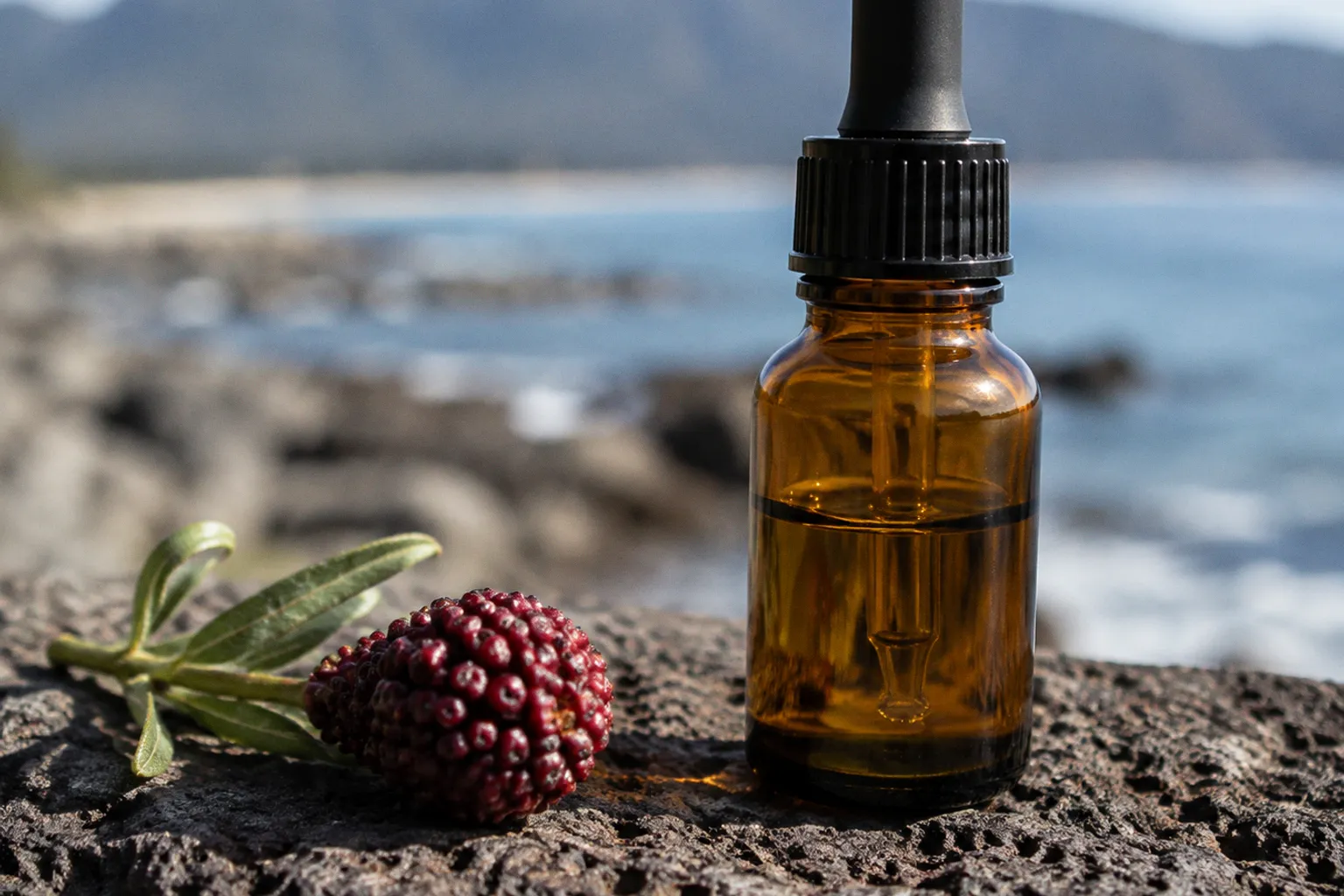
This is where Tasmanian mountain pepper berry (Tasmannia lanceolata) enters the conversation alongside tea tree (Melaleuca alternifolia). Both are native Australian botanicals. Both appear on shelves labelled "acne care." Mechanistically they do different things.
The Biological Divide: Antibacterial Power vs. Neurogenic Soothing
Acne vulgaris is a four-part process: sebum overproduction, follicular hyperkeratinisation, Cutibacterium acnes colonisation, and inflammation. Most over-the-counter actives target one or two of these. Tea tree oil and Tasmanian pepperberry each touch a different lever.
Tea tree oil is bactericidal. Its primary active, terpinen-4-ol, disrupts the cell membrane of C. acnes and reduces bacterial load in the follicle. The compound is well-characterised, standardised under ISO 4730, and clinically benchmarked — at 5% concentration, inflammatory lesion counts (papules and pustules) drop to a degree comparable with 5% benzoyl peroxide, though more slowly.
Tasmanian pepperberry does not chase bacteria. Its active, polygodial, is a sesquiterpene dialdehyde that modulates TRPV1 sensory receptors in the skin — the same receptors that register burning, itching, and stinging. By quieting this sensory signal, polygodial reduces the neurogenic inflammation that keeps a breakout hot, red, and reactive long after the bacterial trigger has been addressed. The extract is also rich in anthocyanins and rutin, which add a third layer of antioxidant defence.
Tea tree oil kills the bacteria. Mountain pepper berry quiets the noise.
Tea Tree Oil: The ISO-Standardized Approach to Bacterial Control
Melaleuca alternifolia oil has been the workhorse of Australian acne care for decades, and its reputation rests on a specific, repeatable chemistry. ISO 4730 — the international standard for "Oil of Melaleuca, terpinen-4-ol type" — sets terpinen-4-ol at 30%–48% and 1,8-cineole below a defined ceiling, with a typical high-quality batch landing at 30%–40% terpinen-4-ol. If a product's certificate of analysis doesn't meet this band, the antibacterial claim is unsupported.
The 1990 Bassett study set the clinical benchmark still cited today: 5% tea tree oil gel reduced inflammatory lesions at a rate statistically comparable to 5% benzoyl peroxide. The trade-off is onset speed. Benzoyl peroxide works in days. Tea tree oil works in weeks. The benefit is tolerability — less dryness, less peeling, less barrier compromise — provided the formula is diluted and the user doesn't over-apply.
A safe, effective range for leave-on acne products is 2%–5% tea tree oil. Anything stronger, or neat application of the essential oil, raises the risk of contact allergy and irritation — particularly on skin already sensitised by retinoids or exfoliating acids.
Layering protocol with tea tree:
1. Cleanse with a low-pH, non-stripping formula (around pH 5.5).
2. Apply a 2%–5% tea tree serum or gel to clean, dry skin, focusing on the breakout zone.
3. Wait 60 seconds. If a niacinamide or panthenol toner is in the routine, layer it on top — it buffers the oil and reinforces the barrier.
4. Seal with a ceramide-rich moisturiser. Occlusion here is not optional; it limits transepidermal water loss and keeps the actives working at the surface where C. acnes lives.
Tasmanian Mountain Pepper Berry: Calming the Skin's Sensory Response
Tasmannia lanceolata has been part of Tasmanian bush food and traditional medicine for centuries; its cosmetic use is newer but increasingly well-documented. The relevant active is polygodial — a pungent dialdehyde that gives the berry its peppery heat — and it works through a different receptor pathway than most cosmetic actives.
TRPV1 is the capsaicin receptor. It's the same receptor chili peppers activate when they burn your tongue. In skin, TRPV1 is over-expressed in acne lesions, rosacea-prone skin, and barrier-compromised complexions. Activation drives the release of neuropeptides that produce visible redness, warmth, and that persistent "angry" sensation even when the lesion is small.
Polygodial is a TRPV1 modulator, not an agonist. It desensitises the receptor without triggering it. In manufacturer in-vivo testing on reactive skin, the extract reduced subjective itching by 79% and burning by 58% within five minutes of application. These figures come from a small panel under controlled conditions, so treat them as directional rather than universal — but the mechanism is reproducible and the receptor target is well-characterised.
Effective concentrations in finished formulas sit between 0.1% and 2%. Above 2%, there's no clear benefit and the cost climbs steeply. Below 0.1%, the soothing effect becomes inconsistent.
The antioxidant layer is harder to ignore. Tasmanian pepperberry carries anthocyanins and rutin at concentrations that, by ORAC-equivalent testing, deliver roughly 3–10 times the free-radical-scavenging activity of blueberries. That's clinically meaningful for acne because reactive oxygen species are a downstream amplifier of inflammation — tackling them reduces the metabolic stress on already-stressed follicles.
| Parameter | Tea Tree Oil | Mountain Pepper Berry |
|---|---|---|
| Primary active | Terpinen-4-ol | Polygodial |
| Mechanism | Bactericidal (membrane disruption) | TRPV1 modulator + antioxidant |
| Standardised reference | ISO 4730 (30%–40% terpinen-4-ol) | 0.1%–2% extract in formulation |
| Onset of action | 2–8 weeks | Minutes (subjective soothing) |
| Best for | Bacterial load, pustules, papules | Redness, irritation, reactive flare-ups |
| Irritation risk | Moderate at >5% or undiluted | Low at recommended concentrations |
| Pairs with | Niacinamide, panthenol, ceramides | Centella asiatica, allantoin, hyaluronic acid |
Antioxidant Profiles and Long-Term Barrier Protection
The third pillar of an acne routine — after killing bacteria and calming the sensory response — is oxidative stress. Lipid peroxidation in the sebum and ROS accumulation around the follicle keep the inflammatory cascade running long after the initial trigger has passed.
Tasmanian pepperberry's anthocyanin and rutin content contributes here. Anthocyanins are flavonoids that neutralise peroxyl radicals; rutin reinforces capillary integrity and reduces post-inflammatory erythema. The combined effect, in formulation, is a skin surface that ages out of a breakout faster — less lingering red mark, less visible post-inflammatory hyperpigmentation.
Tea tree oil carries some antioxidant activity as well — terpinen-4-ol and gamma-terpinene both show modest radical-scavenging capacity — but it's not the headline function. If oxidative load is the primary concern, pepperberry is the better-targeted botanical.
Barrier integrity is the connective tissue between all three pathways. A compromised barrier increases transepidermal water loss (TEWL), which in turn amplifies sensory nerve signalling and makes the skin more reactive to every active applied. The standard Australian mistake is to strip aggressively with tea tree, then skip the occlusive step because "oily skin doesn't need moisture." This is the TEWL feedback loop. Either botanical works better when paired with a ceramide-dominant moisturiser and a low-pH cleanser.
A botanical routine that ignores barrier integrity is a routine that gets quieter for two weeks and then gets loud again.
Strategic Integration: Balancing Potency with Skin Sensitivity
The honest clinical answer to "Tasmanian pepperberry vs tea tree" is that they do different jobs. Using one in place of the other is like using a knife instead of a thermometer — both kitchen tools, both useless when swapped. The intelligent routine uses both, sequenced.
AM routine (maintenance, when skin is reactive):
1. Low-pH cleanse.
2. Hydrating toner (panthenol, glycerin, low-molecular-weight hyaluronic acid).
3. Serum with 0.1%–2% Tasmanian pepperberry extract, focusing on zones of reactivity.
4. Ceramide moisturiser.
5. SPF 50+ (mandatory — post-acne skin is UV-sensitive during repair).
PM routine (when breakouts are active):
1. Double cleanse (oil or balm first, then low-pH gel).
2. 2%–5% tea tree serum or spot treatment on active lesions only.
3. Buffer with a niacinamide or centella asiatica layer.
4. 0.5%–2% Tasmanian pepperberry extract to calm neurogenic redness around the breakout.
5. Ceramide-rich night moisturiser to occlude and limit TEWL overnight.
Concentrations and forms to look for:
- Tea tree: "Melaleuca alternifolia oil" listed in the top half of the ingredient list at 2%–5%, with a certificate of analysis confirming ISO 4730 compliance.
- Pepperberry: "Tasmannia lanceolata fruit/leaf extract" or "mountain pepperberry extract" at 0.1%–2%.
- Avoid: undiluted essential oils, "100% pure" tea tree applied neat, or any formulation above pH 6.5 that destabilises both actives.
Troubleshooting Checklist
When the routine isn't delivering:
- Breakouts are still red and angry after four weeks. Bacterial load may be controlled; neurogenic inflammation is not. Add or increase a Tasmanian pepperberry extract at 0.5%–1%.
- Skin feels tight, shiny, or peels within a week. Barrier is compromised. Discontinue tea tree temporarily, layer only ceramide moisturiser for seven days, then reintroduce the oil at 2%.
- Itching persists despite no visible dryness. Likely TRPV1 over-signalling. Pepperberry extract at the upper end (1%–2%) applied twice daily.
- Post-inflammatory marks linger for months. Oxidative load is high. Increase pepperberry concentration and consider a separate vitamin C serum — Kakadu plum-derived ascorbic acid keeps the routine A-beauty-aligned.
- Pustules keep forming in the same spot. Bacterial colonisation, not inflammation, is the driver. Reassess tea tree concentration — move toward 5% and confirm ISO-grade sourcing.
The Australian acne toolkit doesn't need a dozen actives. It needs a sequenced two-botanical protocol — one that addresses the bacterial trigger, one that quiets the inflammatory response — held together by a barrier-first routine. That's the architecture. Build it once, run it consistently, and the skin settles faster than any single ingredient could manage alone.