Fruit Enzyme Exfoliation: How Gentle Peels Work
Papain and bromelain exfoliate through proteolysis. They hydrolyze protein bonds associated with dead corneocytes in the stratum corneum. They do not need the low pH used by glycolic, lactic, or salicylic acid products.
Jude Carstairs·Updated: September 05, 2026·15 min read
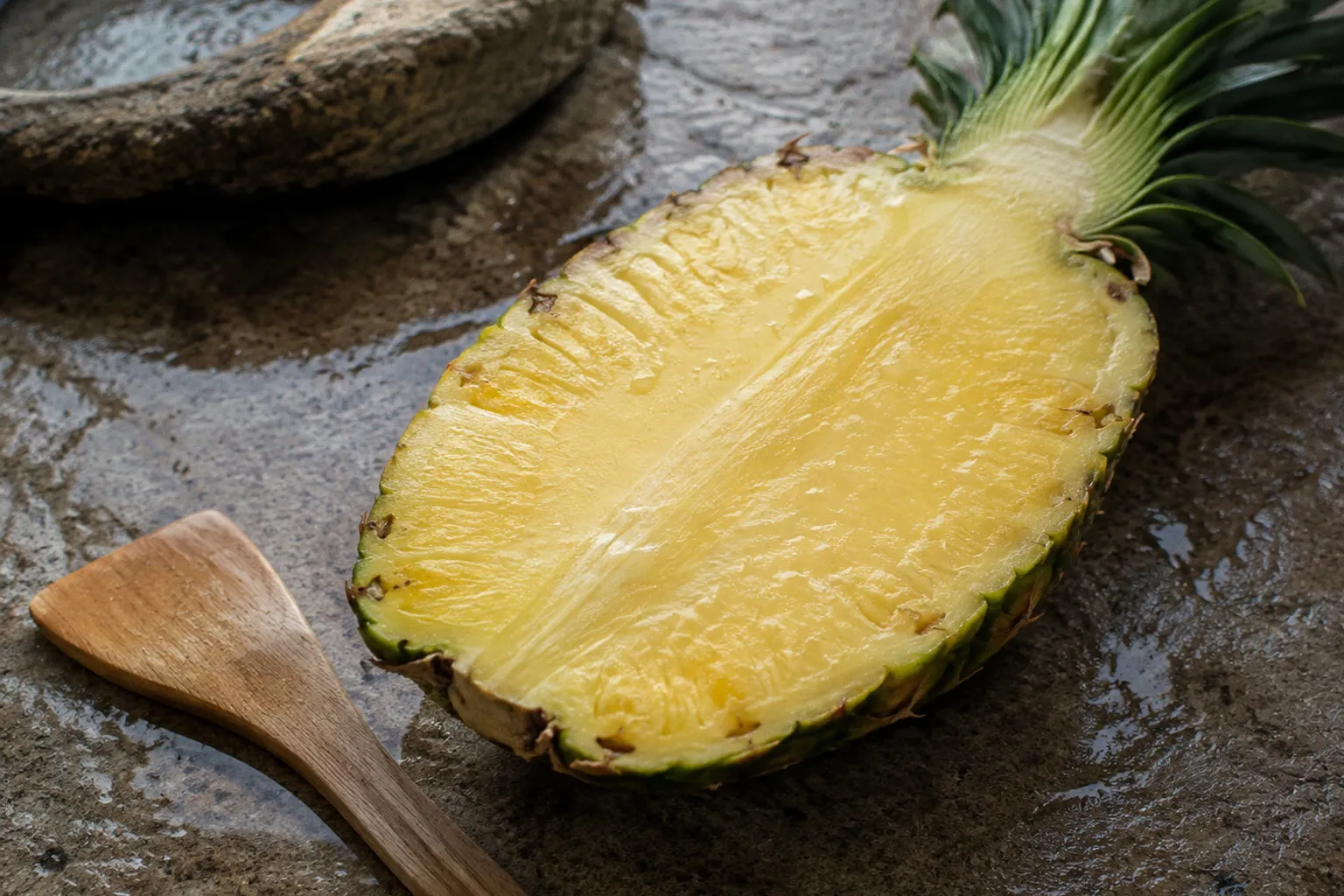
That distinction explains why a gentle enzyme exfoliation routine can be better tolerated by sensitive, reactive, or acid-intolerant skin. The mechanism is different. Enzymes target keratin proteins at the surface. Acids alter the chemical environment and weaken the intercellular matrix that holds corneocytes together.
Neither approach is universally superior. The relevant variables are barrier condition, formulation pH, enzyme stability, exposure time, and frequency. A botanical label does not resolve those variables.
The science of proteolysis: how fruit enzymes target keratin
Fruit enzyme exfoliation usually refers to proteolytic enzymes derived from papaya and pineapple.
- Papain is obtained from papaya.
- Bromelain is obtained from pineapple.
- Both are proteolytic cysteine enzymes.
- Their function is to hydrolyze selected protein bonds.
- Their action is concentrated in the outer stratum corneum rather than the living epidermis or dermis.
The stratum corneum is composed of flattened, protein-rich corneocytes surrounded by a lipid matrix. These cells are connected by corneodesmosomes and other protein structures. Normal desquamation involves the gradual breakdown of these connections. Exfoliation accelerates that process.
Papain and bromelain support this process by acting on keratin-associated proteins between accumulated dead cells. The result is a reduction in cohesion at the surface. The process is enzymatic rather than primarily acid-driven.
This matters because pH is not the sole determinant of exfoliating activity. Papain has an optimal activity window between pH 5.0 and 7.0. That range is compatible with mildly acidic or near-neutral cosmetic formulations. The product does not need to reach the strongly acidic conditions associated with many alpha hydroxy acid products.
The distinction should not be overstated. An enzyme does not selectively remove only the cells a user considers undesirable. Activity depends on concentration, contact time, formulation, water content, pH, temperature, and the condition of the skin. A rinse-off powder cleanser and a leave-on mask can contain the same enzyme name but behave differently.
Molecular activity also varies between raw materials. Cosmetic suppliers may describe potency using different assay systems or activity units. There is no universal standard that makes enzyme strength directly comparable across every commercial formulation. The ingredient list alone cannot establish exfoliating intensity.
A specialized powder cleanser, for example, may contain papain at approximately 1,923.92 parts per million. That figure is not a universal threshold for efficacy or irritation. It is a formulation detail. The enzyme may be active, partially denatured, or buffered in a way that changes its actual performance on skin.
Enzyme exfoliation is not acid exfoliation with a botanical marketing label. It is a different chemical mechanism with different formulation constraints.
Enzyme peel versus acid exfoliation
The most common comparison is not whether enzymes exfoliate. They do. The more useful question is how their activity compares with acids in a specific routine.
Alpha hydroxy acids such as glycolic and lactic acid are water-soluble acids. They work through pH-dependent effects on the bonds and matrix components that maintain cohesion between corneocytes. Beta hydroxy acid, most commonly salicylic acid, is oil-soluble and has a different distribution profile within sebum-rich follicular environments.
Fruit enzymes act on protein structures. They do not depend on lowering skin pH in the same way. This often changes the immediate sensory profile. Acid products can produce tingling or stinging because of low pH and free-acid concentration. Enzyme products may be less likely to create that response when correctly formulated and used briefly.
That does not make enzymes incapable of irritation. Protein-degrading activity can still be excessive. Papaya and pineapple-derived materials can also be problematic for individuals with relevant allergies or highly reactive skin. Preservatives, fragrance compounds, essential oils, and surfactants may create more irritation than the enzyme itself.
| Parameter | Fruit enzyme exfoliation | AHA/BHA exfoliation |
|---|---|---|
| Primary mechanism | Proteolysis of surface protein structures | pH-dependent chemical exfoliation |
| Common actives | Papain and bromelain | Glycolic, lactic, mandelic, or salicylic acid |
| Formulation pH | Papain performs within approximately pH 5.0–7.0 | Effect depends strongly on pH and free-acid availability |
| Typical barrier concern | Overexposure, enzyme instability, combined irritants | Stinging, excessive desquamation, barrier disruption |
| Suitability for acid-intolerant skin | Potentially useful, depending on formulation and skin condition | May be poorly tolerated |
| Sebum and pore activity | Primarily surface-focused | Salicylic acid has greater relevance to oil-rich follicles |
| Pregnancy routine context | Often selected as an alternative to retinoids and stronger acids, but product-specific review remains necessary | Ingredient and concentration must be assessed individually |
| Main limitation | Potency is difficult to standardize across products | Stronger formulations can be predictable but irritating |
A gentle enzyme exfoliation routine is therefore not a universal replacement for acids. It is a lower-intensity surface exfoliation strategy. It may be appropriate when the primary objective is to reduce surface roughness without introducing a strongly acidic product.
For comedonal acne, the distinction is more significant. Enzymes can remove some superficial buildup, but they should not be treated as a substitute for an acne-directed active. They do not have the same follicular relevance as salicylic acid, nor do they address Cutibacterium acnes through the same mechanisms as established acne treatments.
For dullness caused by retained corneocytes, an enzyme product may be sufficient. For persistent inflammatory acne, closed comedones, or recurrent follicular congestion, the routine requires a different assessment.
Why sensitive skin may tolerate enzymes better
Sensitive skin is not a single biological category. It may reflect impaired barrier function, irritant contact dermatitis, allergic contact dermatitis, rosacea-associated reactivity, or temporary inflammation from over-exfoliation.
A compromised lipid barrier increases transepidermal water loss and allows irritants to produce a stronger response. Low-pH acids can then become difficult to tolerate, particularly when combined with retinoids, benzoyl peroxide, strong cleansers, or frequent physical exfoliation.
Enzymes can reduce one source of stress because they do not require the same low pH. A formulation around the papain activity range can remain mildly acidic to neutral. This reduces dependence on a sharp pH shift at the skin surface.
The benefit is conditional. Barrier compatibility depends on the entire product:
- A papain cleanser with a mild surfactant system is not equivalent to a papain peel with alcohol and fragrance.
- A buffered enzyme mask is not equivalent to fresh fruit puree.
- A short-contact product has a different risk profile from an overnight treatment.
- A low enzyme concentration used repeatedly can still cause cumulative irritation.
- A product with bromelain may include pineapple-derived compounds that are unsuitable for some users.
The term “gentle” should describe the protocol, not the source plant. Botanical origin does not predict irritation, efficacy, or safety. Poison ivy is botanical. So is glycolic acid in its natural sources. The relevant question is formula behavior.
For reactive skin, the correct application sequence is deliberately limited:
1. Cleanse with a non-stripping product.
2. Apply the enzyme product according to its intended contact time.
3. Rinse thoroughly if it is a rinse-off formulation.
4. Follow with a bland moisturizer containing barrier-supportive lipids, humectants, or occlusives.
5. Avoid adding acids, retinoids, scrubs, or peroxide in the same session.
6. Use broad-spectrum sunscreen during the day.
The routine should not produce persistent burning, swelling, or erythema. If that occurs, the product is not functioning as a tolerable exfoliant for that skin, regardless of its botanical positioning.
Bromelain and papain: different enzymes, different formulation logic
Papain and bromelain are often grouped together in marketing. They are not interchangeable raw materials.
Papain performs optimally in a pH range of approximately 5.0 to 7.0. This gives formulators a relatively broad compatibility window for mildly acidic skincare products. The enzyme remains sensitive to heat and can lose activity when exposed to elevated temperatures.
Bromelain also has proteolytic activity. It is associated with anti-inflammatory effects, including inhibition of prostaglandin synthesis. This may support a calmer response during surface exfoliation, but it does not make bromelain an anti-inflammatory treatment for a diagnosed skin disease. It also does not guarantee that every bromelain-containing product will reduce redness.
The final effect depends on:
- the botanical source;
- extraction and purification method;
- enzyme activity rather than ingredient weight alone;
- pH;
- water activity;
- preservative system;
- packaging;
- storage temperature;
- contact time;
- the presence of competing or denaturing ingredients.
Ingredient percentages can be misleading. A higher percentage of a dry fruit extract does not necessarily mean higher active enzyme potency. Extracts may contain sugars, acids, proteins, minerals, and inactive plant material. Conversely, a lower concentration of a standardized enzyme preparation may deliver greater measurable activity.
This is one reason commercial enzyme products cannot be ranked by the word “organic” or by the position of the botanical name on the label. Organic certification concerns agricultural and manufacturing standards. It does not establish the proteolytic activity of papain or bromelain on skin.
The same logic applies to “fresh” fruit. Fresh pineapple or papaya contains enzymes, but kitchen preparation is not a controlled cosmetic formulation. Concentration is variable. pH is variable. Preservation is inadequate. Exposure time is difficult to control. Fruit pulp can also contain compounds that irritate or sensitize the skin.
Heat is an additional problem. Enzymes are proteins. Elevated temperatures can denature them and reduce their functional activity. Heat-processed canned fruit therefore cannot be assumed to retain meaningful exfoliating efficacy. A canned fruit puree is not an enzyme peel.
Building a gentle enzyme exfoliation routine
A botanical enzyme skin routine works best when exfoliation is treated as one controlled event in a broader regimen. It should not compete with every other active.
The first decision is product format.
Powder cleansers
Powder formulas are activated with water immediately before use. They can limit long-term exposure of the enzyme to water, which may support stability. Their activity still depends on storage and handling. A damp container can compromise the formula.
The cleanser should be mixed with enough water to distribute it evenly. Aggressive rubbing is unnecessary. Mechanical friction adds a separate exfoliating stimulus and can undermine the purpose of using an enzyme product for sensitive skin.
Rinse-off masks and peels
These products provide longer contact time. That may increase exfoliating activity, but it also increases the potential for irritation. The recommended contact time should be treated as an upper limit, not an invitation to extend the application.
The first use should be conservative. The product should not be applied immediately after shaving, waxing, sun exposure, or another exfoliating treatment. Barrier disruption changes the response to almost every active.
Toners and mists
A calming facial toning mist can follow cleansing, but it should not be assumed to neutralize an enzyme. Enzymes do not require the acidic neutralization step associated with some chemical peel systems. A mist is useful only if its formula supports hydration and does not add fragrance, volatile alcohol, or another irritant.
Oils
Nourishing facial oil layering belongs after water-based products and moisturizers, not before an enzyme treatment. Oil can alter wetting and distribution if applied first. It can also make rinsing less complete. The exception is a product specifically formulated as an oil-dispersed enzyme system, which requires its own directions.
A practical weekly schedule can remain simple:
- Enzyme exfoliation on one evening.
- Retinoid or other active on a separate evening, if already tolerated.
- Barrier-recovery nights between stronger treatments.
- No physical scrub layered over the enzyme.
- No attempt to compensate for slow results by increasing frequency.
In a standard four-night skin cycling framework, enzyme exfoliation can replace stronger acids on Night 1. Night 2 may be reserved for a retinoid. Nights 3 and 4 are used for barrier recovery. The sequence is not mandatory, but the separation reduces the chance of cumulative irritation.
A pregnancy-safe skincare routine requires additional care. Enzyme exfoliation is often considered as an alternative to retinoid-centered routines or stronger acid protocols, but “pregnancy-safe” cannot be assigned to a product from the botanical ingredient name alone. The full ingredient list, concentration, product format, and personal medical context matter. A clinician should review any regimen used during pregnancy when there is uncertainty.
The correct frequency is the highest frequency that preserves barrier function. For many reactive skin types, that means less often than the product’s marketing suggests.
Barrier repair determines whether exfoliation works
Exfoliation does not improve the appearance of compromised skin by default. If the lipid barrier is impaired, additional desquamation can produce more roughness, erythema, and dehydration.
The stratum corneum depends on an organized balance of ceramides, cholesterol, and fatty acids. These lipids limit water loss and regulate penetration of external substances. Enzyme exfoliation acts mainly on surface proteins, but an already unstable surface may respond poorly to any additional disruption.
A sensitive skin barrier repair routine should therefore precede frequent exfoliation. The baseline regimen should include:
- a low-irritation cleanser;
- a moisturizer with humectant and occlusive support;
- a compatible lipid system where tolerated;
- daily photoprotection;
- minimal simultaneous use of high-activity ingredients.
The condition of the skin can be assessed through response rather than appearance alone. Tightness after cleansing, persistent stinging from bland products, flaking, and prolonged redness indicate that the routine is exceeding current tolerance. In that state, stopping exfoliation is more rational than changing from one exfoliant to another.
This is also where the enzyme-versus-acid comparison becomes less useful. A low-pH acid may be irritating. An enzyme may also be irritating. The formula and exposure determine the outcome. A poorly preserved, highly concentrated, fragranced enzyme product is not automatically safer than a well-buffered acid product used at a controlled frequency.
Stability and efficacy: why formulation matters more than the fruit
The central technical limitation of fruit enzymes is stability.
Papain and bromelain are heat-sensitive proteins. Processing, storage, and packaging can reduce their activity. A product may still list papain or bromelain after the active enzyme has lost a significant portion of its functional capacity. The ingredient list confirms presence. It does not confirm current activity.
Water also changes the stability problem. Once an enzyme is in an aqueous formula, the formulator must control pH, preservation, temperature, and interactions with other ingredients. Powder formats can reduce some stability challenges, but they introduce dosing and activation variability.
Subtilisin illustrates why enzyme choice matters. Its optimal pH range is approximately 7.5 to 9.5, which differs substantially from papain. A formula designed around one enzyme cannot be evaluated using assumptions about another. The pH, buffering system, and intended contact time must match the active.
Packaging is part of the formula. An opaque, well-sealed container may protect sensitive ingredients better than an open jar stored in a warm, humid bathroom. Repeated exposure to moisture and heat can reduce performance. This is not a cosmetic detail. It is an activity-control issue.
A reliable product description should provide enough information to establish the intended use:
- whether the product is rinse-off or leave-on;
- whether it is activated with water;
- the recommended contact time;
- storage requirements;
- the presence of fragrance or essential oils;
- the relevant enzyme type;
- the expected frequency.
Claims such as “dissolves dead skin,” “detoxifies pores,” or “renews skin from within” are less useful than formulation data. Enzymes do not dissolve the lipid barrier. They do not penetrate into the deep dermis. They act primarily at the surface, where the relevant protein structures are located.
A controlled protocol for acid-intolerant skin
For someone replacing an acid exfoliation routine, the transition should be gradual. The objective is not to recreate the intensity of glycolic acid with a different label.
Start with a clean, dry or damp face according to the product instructions. Avoid pre-exfoliating with a scrub or cleansing brush. Apply a thin, even layer. Keep the first exposure short. Rinse thoroughly where required. Follow with a non-active moisturizer.
The following variables should remain stable during the first several uses:
- cleanser;
- moisturizer;
- sunscreen;
- enzyme product frequency;
- contact time.
Changing multiple products at once makes the response impossible to interpret. If irritation develops, the product may be responsible, but so may the cleanser, fragrance, preservative system, or concurrent active.
Patch testing has limitations. It can identify some immediate or localized reactions, but it cannot predict the complete facial response to repeated exfoliation. A delayed increase in dryness may emerge only after several applications.
For acne-prone skin, the routine should be calibrated to the lesion type. Surface flaking and roughness may respond to controlled enzymatic exfoliation. Persistent papules, pustules, cysts, and closed comedones require a more specific acne strategy. Fruit enzymes should not be positioned as a complete acne treatment.
For rosacea-prone or highly reactive skin, the threshold is lower. Bromelain’s anti-inflammatory potential does not override individual reactivity. Any product that causes persistent warmth, burning, swelling, or visible inflammation should be discontinued.
The definitive assessment
Fruit enzyme exfoliation is a legitimate cosmetic technology. Papain and bromelain hydrolyze protein structures associated with dead stratum corneum cells. They can provide surface exfoliation without relying on a strongly acidic pH. That makes them a rational option for some sensitive, reactive, or acid-intolerant routines.
The limitations are equally clear. Enzyme potency is difficult to compare across products. Heat and storage can reduce activity. Botanical origin does not establish tolerance. Enzymes do not replace acne medication, retinoids, or clinically indicated treatment. They do not repair a damaged barrier by themselves.
The most defensible use is controlled and infrequent. Select a stable formulation. Follow the contact-time instructions. Separate the product from other exfoliating or irritating actives. Support the lipid barrier. Treat “gentle” as a response to be demonstrated by the skin, not as a promise created by the label.
A gentle enzyme exfoliation routine can be effective when the target is superficial corneocyte buildup and the formula is chemically competent. Its value is not that it is natural. Its value is that proteolysis offers a different route to controlled desquamation.