Facial Oil Layering: Is It Worth Adding to Your Routine?
A tight, papery feeling after cleansing is not a hydration problem in the strict sense — it is a barrier problem.
Iris Ellingham·Updated: September 06, 2026·8 min read
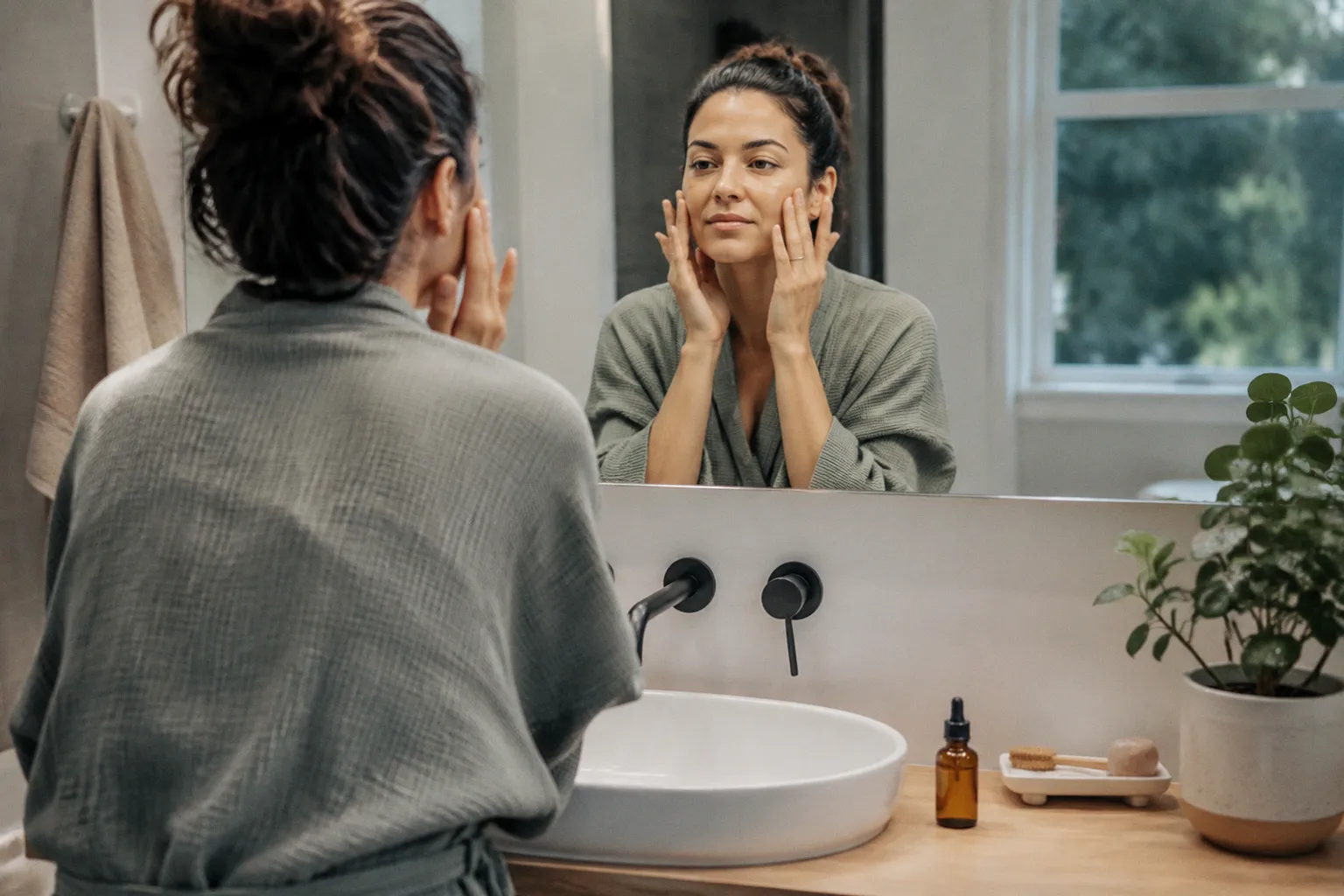
Moisture is escaping through a compromised stratum corneum faster than the deeper layers can replace it, a measurable flux known as transepidermal water loss. Botanical oils address this not by pouring water back into the skin but by laying down a lipid veil that slows the escape, and the compound doing most of the structural work is linoleic acid — a polyunsaturated fatty acid concentrated in oils like rosehip seed, evening primrose, and hempseed.
Layering these oils correctly transforms them from a finishing flourish into a repair step. Done wrong, they can do little — or worse, interfere with the layers beneath. Done right, two to four drops become the quiet closing move of a routine built for a steady, dewy glow.
The Science of Occlusion: Why Oils Seal Rather Than Hydrate
A common misconception drives many facial oil purchases: the belief that oil hydrates. It does not, at least not in the way a humectant like glycerin or hyaluronic acid does. Those ingredients bind water and pull it into the stratum corneum; oils do not carry water into the skin at all.
What botanical oils do — and do exceptionally well — is occlude. Once pressed onto the skin's surface, lipid molecules arrange themselves into a thin, semi-permeable film. That film does not replace water; it slows the water already inside the skin from evaporating into the air. The mechanism is mechanical and well documented: by reducing transepidermal water loss, oils give the barrier time to rebuild its own intercellular matrix — the mortar-and-brick architecture of ceramides, cholesterol, and free fatty acids that holds skin cells together.
Different oils offer different lipid profiles, and that profile shapes how the barrier responds. Linoleic acid-rich oils (rosehip seed, evening primrose, hempseed) integrate more readily into a compromised barrier because the skin's ceramide precursors share structural similarities with this fatty acid. Oleic acid-dominant oils (olive, avocado, marula) feel richer on the skin but can feel heavy on reactive complexions and are sometimes associated with slower barrier recovery in compromised states. Squalane — a hydrocarbon now commonly derived from plant sources like sugarcane or olives — sits between these two profiles: chemically stable, non-comedogenic for most skin types, and structurally close to the skin's own sebum.
An oil does not hydrate. It holds the water already inside your skin from leaving — and gives the barrier time to do its own repair work.
The Golden Rule of Consistency: Sequencing Your Skincare Layers
The single most useful sentence in skincare layering is older than the modern multi-step routine: thinnest to thickest, water-based before oil-based. This rule survives because it reflects a physical reality — each layer must be able to pass through the one above it, or the active ingredients in the lower layers never reach the skin.
In practice, a glowing-skin routine that ends with facial oil usually follows this order: a water-based cleanser (or an oil cleanse followed by a water cleanse), a hydrating toner or essence if used, a serum — particularly one with water-soluble actives like niacinamide, vitamin C derivatives, or polyglutamic acid — and a moisturizer. The facial oil sits on top of all of these as a finishing layer, sealing them in.
There are three legitimate placements for a facial oil in a routine, and the differences are worth understanding:
| Method | How it works | Best for | Watch-out |
|---|---|---|---|
| Over moisturizer | Pressed onto skin after moisturizer has absorbed; creates the most occlusive seal | Dry, barrier-compromised, or mature skin; evening routines | Can feel heavy in humid climates or on oily skin |
| Mixed into moisturizer | Two to four drops blended into the moisturizer in the palm before application | Normal to combination skin; morning routines where a lighter finish is desired | May reduce efficacy of actives in the moisturizer if not pressed in properly |
| Onto slightly damp skin | Applied after a hydrating toner while the skin still holds a film of water | Dehydration-prone skin chasing a dewy finish | Over-wet skin dilutes the oil; pat, don't drench |
The one placement that fails almost every time is oil first, with everything else layered on top. Heavy oils create a hydrophobic film that repels water-based serums and essences, leaving expensive actives sitting on the surface where they cannot penetrate.
Precision Application: The 2-to-4 Drop Technique for Maximum Glow
The instinct to pour freely from the dropper is the second most common facial oil mistake, after the wrong sequence. More oil does not mean more benefit; it means a film thick enough to feel greasy, to pill under makeup, and to clog the pores that are most susceptible along the lower cheeks and jawline.
The amount that formulation chemists converge on is two to four drops for the entire face and neck. The variation depends on the oil's viscosity and the area being treated. A light, fast-absorbing squalane needs closer to four drops to cover face and neck; a richer rosehip or marula can do the same work in two.
The technique matters as much as the amount. Warming the drops between the palms — not rubbing them into the fingers first — distributes the oil evenly across the skin's surface without tugging. Then the application: press, don't rub. Pressing transfers the oil without disturbing the moisturizer and serum layers beneath. Rubbing can mechanically roll those layers, exfoliating in a way the routine did not ask for, and can generate the kind of friction that inflames reactive skin.
For the eye area, the amount drops further — a single drop split between both upper eyelids and the under-eye zone is usually enough. The skin here is roughly 0.5 mm thick, among the thinnest on the body, and it absorbs topicals more readily than the cheek. Pressing with the ring finger, which exerts the least pressure, prevents the micro-tension that contributes over time to fine lines from repeated pulling.
Strategic Timing: Why Waiting 90 Seconds Changes Your Results
Each layer in a skincare routine needs a moment to settle before the next one goes on. The commonly cited figure is 30 to 90 seconds — a wide range that reflects real variation in product weight. A watery toner absorbs in under half a minute; a richer moisturizer can take the full minute and a half.
Two reasons sit behind the wait. First, a layer that has not yet absorbed sits on the skin as a film rather than a functional treatment; the next product applied over it mixes with that film rather than reaching the skin beneath, diluting both formulations. Second, certain actives — particularly water-soluble vitamin C derivatives and some peptide complexes — benefit from a brief window of undisturbed contact with the skin, where pH-driven reactions can complete before the next product changes the surface environment.
For facial oil specifically, the wait is built into the placement. When oil goes over moisturizer, the moisturizer should feel settled — not tacky, not wet, but softly primed. When oil is mixed into the moisturizer, the wait collapses; the two are applied as one. When oil goes onto damp skin after a hydrating toner, the wait also shortens, because the toner's water content is meant to be trapped, not evaporated.
A useful rhythm for an evening barrier-repair routine: cleanse, wait for skin to air-dry or gently pat dry, apply toner or essence (wait 30 seconds), apply serum (wait 60 seconds), apply moisturizer (wait 90 seconds), apply two to four drops of facial oil pressed between palms. By the time the oil goes on, the skin beneath is ready to receive it as a finishing seal.
The SPF Boundary: Protecting Your Routine from Oil Interference
Sunscreen sits in a category of its own in any daytime routine. Mineral filters like zinc oxide and titanium dioxide, and chemical filters like avobenzone and mexoryl, are formulated to form an even, undisturbed film across the skin's surface. That film is the protective barrier against ultraviolet radiation, and its integrity is the entire point of wearing SPF.
This is why facial oil must always go under sunscreen in a morning routine, never over it. An oil applied on top of sunscreen dilutes the UV filter, redistributes it unevenly, and creates the channels through which UV radiation can reach the skin unfiltered. The protective factor of the sunscreen drops, sometimes significantly, depending on how much oil is applied and how much it is spread.
The practical implication is straightforward: in the morning, the layering order ends with broad-spectrum SPF 30 or higher. Any facial oil used during the day belongs beneath it — either mixed into the moisturizer, pressed onto damp skin after a hydrating step, or applied before the sunscreen if the formulation is light enough to absorb without residue. If the oil feels too rich for daytime comfort, save it for the evening routine, where its occlusive function works without competing against a UV filter.
Sunscreen is the closing layer of any morning routine. Oil placed over SPF dilutes the filter and undermines the protection the rest of the routine is built around.
For skin that is functioning well, facial oil is optional — a finishing flourish that adds slip and a dewy finish without doing significant structural work. For skin with a compromised barrier, recurrent dehydration, or visible flaking around the nose and chin, facial oil becomes less optional: it is the step that holds the rest of the routine together, slowing water loss long enough for the ceramide-rich layers beneath to complete their repair.
The right oil, in the right sequence, in the right amount, pressed rather than rubbed, after a brief wait — these are small adjustments with outsized effects. Two to four drops of a linoleic-rich botanical oil, layered over a moisturizer in the evening, are not a luxury add-on. They are a structural choice, and one of the simplest available for bringing a daily organic skincare regimen closer to its intended glow.