CO2 Extracts vs Cold-Pressed Oils: Which Suits Your Skin?
You're scanning the ingredient list on two serums. One highlights a cold-pressed rosehip oil base; the other advertises a CO2-extracted sea buckthorn concentrate.
Leo Ashdown·Updated: September 06, 2026·8 min read
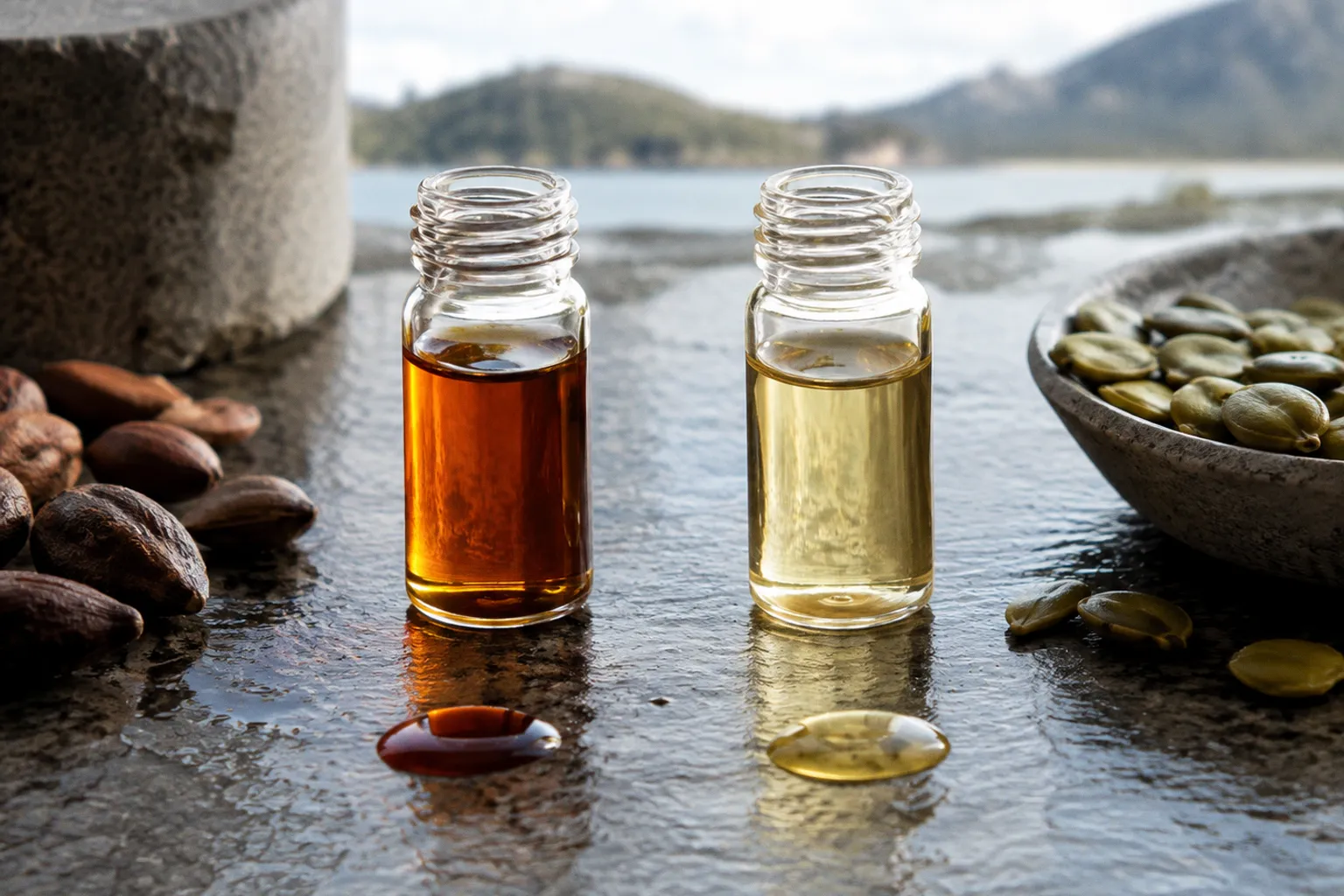
Both claim to be clean, both promise botanical potency, and neither tells you why the extraction method actually matters for your skin. The distinction isn't marketing language — it's the single biggest factor deciding whether you get a whole-lipid nourisher or a concentrated, heat-stable active on your face.
The confusion tends to surface at the exact moment a routine stalls. Someone with a compromised barrier reaches for a cold-pressed oil expecting an antioxidant hit and gets comfort instead — which is fine, just not what they needed. Someone targeting post-inflammatory marks loads up on a CO2 extract and skips the lipid layer their barrier was asking for. The extraction method is the variable that determines which role a botanical plays in your routine.
The Mechanics of Mechanical Cold-Pressing: Friction and Heat Limits
Cold-pressing sounds like a gentle, heat-free process. Mechanically, it is — but friction is unavoidable. Screw presses or horizontal hydraulic plates squeeze oil-rich seeds and fruit peels under enormous pressure, and that mechanical work converts into heat. Processing temperatures routinely climb to a maximum of around 49°C, which is the conventional ceiling for a product to still carry the "cold-pressed" label.
That ceiling matters more than it sounds. A seed oil expressed at 40–49°C still retains its full fatty acid profile — the oleic, linoleic, and linolenic acids your barrier needs to buffer transepidermal water loss. What you lose is the volatile, heat-sensitive fraction: certain polyphenols, delicate aroma compounds, and the more fragile carotenoids degrade above that threshold. The trade-off is deliberate. Cold-pressing is designed to deliver whole-lipid nourishment, not to chase maximum antioxidant concentration.
Yield reflects that priority. Mechanical cold-pressing recovers roughly 40–70% of the oil available in the seed or peel. The remaining 30–60% stays bound in the press cake, often loaded with actives the press couldn't liberate. For a carrier oil in a moisturizer or a cold-pressed facial oil blend, that's an acceptable loss. For a targeted serum, it isn't.
Supercritical CO2 Extraction: The Science of Oxygen-Free Potency
Supercritical CO2 extraction runs at the opposite end of the temperature spectrum. Pressurized carbon dioxide is pushed past its critical point — around 73.8 bar (7.38 MPa) — at temperatures held near 30–31.1°C. In that state, CO2 behaves as both a liquid and a gas: it penetrates plant material like a solvent but diffuses out cleanly when pressure is released.
The process is oxygen-free. That single fact is the reason CO2 extracts exist as a category. Heat-sensitive compounds — tocopherols, sterols, certain flavonoids, and fragile carotenoids — survive extraction because the temperature stays low and there's no oxidative stress during the run. Once the pressure drops, CO2 reverts to gas and vents off, leaving zero solvent residue. What remains is a dense, often paste-like extract with a far higher concentration of target bioactives than the source plant could ever deliver in a whole-oil format.
Yield tells the same story from a different angle. CO2 extraction recovers 85–98% of the target extractables from raw botanical material. That's not 40–70% of bulk oil — it's nearly everything worth pulling out of the plant cell matrix. For formulators building a brightening botanical serum or a concentrated antioxidant booster, that recovery rate is the whole point.
The two methods aren't competing on the same axis: cold-pressing preserves whole lipids, supercritical CO2 isolates delicate actives. Pick the one that matches your skin goal.
Yield and Purity: Why Extraction Methods Change Phytosterol Profiles
This is where the distinction becomes clinically relevant. A comparative study on seed oils published in 2024 found that supercritical CO2 extraction significantly increased total phytosterol content compared to mechanical cold pressing — the pumpkin seed oil data in particular showed a clear jump in recoverable sterols when processed under CO2. Phytosterols matter for skin: they reinforce the lipid matrix, support barrier integrity, and carry their own anti-inflammatory signaling.
But the comparison isn't one-directional. Cold-pressing preserves the full triglyceride architecture of the seed — the fatty acid ratios that occlude, cushion, and slow water loss across a damaged barrier. CO2 extracts can be selectively tuned to pull phytosterols and antioxidants while leaving behind much of the triglyceride bulk, which is why they're typically used at low percentages in a finished formula rather than as the base.
The practical takeaway: if you care about barrier repair, the cold-pressed carrier oil is doing structural work. If you care about delivering a concentrated dose of a specific bioactive — a pumpkin sterol complex, a rosehip carotenoid fraction, a sea buckthorn palmitate — the CO2 extract is doing precision work. Both are real. Neither replaces the other.
At a glance
| Parameter | Cold-Pressed Oils | Supercritical CO2 Extracts |
|---|---|---|
| Processing temperature | Up to ~49°C (friction-generated) | ~30–31.1°C (held) |
| Pressure | Mechanical screw or hydraulic | ~73.8 bar (7.38 MPa) |
| Solvent residue | None | None (CO2 reverts to gas) |
| Oxygen exposure | Present during pressing | Oxygen-free environment |
| Typical yield | 40–70% of available oil | 85–98% of target extractables |
| Delivers | Whole-lipid profile (fatty acids, triglycerides) | Concentrated bioactives (phytosterols, carotenoids, tocopherols) |
| Best role in routine | Barrier nourishment, carrier base | Targeted active boost, antioxidant precision |
| Heat-sensitive compounds | Partially degraded above 40°C | Largely preserved |
Selecting Your Botanical Profile: Whole-Lipid Nourishment vs Concentrated Actives
The choice between these two isn't about which method is "better." It's about which role you need filled in your routine right now. That's the sequencing problem worth solving before you buy.
If your skin is showing classic barrier compromise — tightness after cleansing, visible flaking, stinging when you layer actives — the right botanical is almost always a cold-pressed carrier oil. The whole-lipid profile delivers linoleic and oleic acid in their natural ratios, which is what a disrupted barrier needs to rebuild its lipid mortar. Apply it after a hydrating step, occlude it with a clean moisturizer, and let the fatty acids do their structural work overnight.
If your skin is intact but you're targeting something specific — uneven tone from past breakouts, early oxidative damage, dullness that hydration alone won't fix — that's where a CO2 extract earns its place. The concentrated phytosterol and carotenoid payload delivers a measurable dose of the active you're after without the bulk of a carrier oil weighing the formula down. Layer it under a clean hydrating moisturizer, not over a heavy occlusive, so the actives can penetrate.
Most routines that stall do so because the two roles get confused. A CO2 extract used as a barrier oil feels underwhelming because it isn't built to occlude. A cold-pressed oil used as an antioxidant serum feels underwhelming because the fragile polyphenol fraction was lost to friction heat during pressing. Match the extraction to the job and the routine starts working again.
Stability and Residue: Debunking Myths About Solvent-Free Purity
Both methods carry a "clean" label, but for different reasons, and the difference is worth understanding if you're building a routine around ingredient integrity.
Cold-pressed oils are solvent-free by definition — no hexane, no ethanol, no chemical extraction step. What they don't escape is heat and oxygen. The friction-generated 40–49°C peak and the air exposure during pressing both contribute to oxidation over time. That's why cold-pressed oils have a finite shelf life and benefit from opaque packaging and cool storage. It's also why they often carry added antioxidants like tocopherol in the final formula — to slow down what the extraction process has already begun.
CO2 extracts are solvent-free in a stricter sense. Carbon dioxide is inert, non-toxic, and reverts to gas once the run finishes. There's no chemical residue because there's no chemical solvent involved — only pressurized CO2, which leaves the extract as soon as pressure drops. The oxygen-free environment during extraction also means the resulting extract is more oxidation-stable to start with. The trade-off is concentration: a CO2 extract is potent, sometimes overwhelmingly so, and is almost always diluted into a base formula rather than applied neat.
If your barrier is compromised, reach for the cold-pressed oil. If your barrier is intact and you're targeting an active, reach for the CO2 extract. The label is a clue, not a verdict.
The Bottom Line
Cold-pressing and supercritical CO2 extraction aren't rivals. They're two tools built for two different jobs in a botanical routine. Cold-pressed oils deliver whole-lipid nourishment — the fatty acid architecture your barrier needs to hold water, occlude, and recover. CO2 extracts deliver concentrated, heat-stable bioactives — the phytosterols, carotenoids, and delicate antioxidants that don't survive friction heat but do survive a pressurized, oxygen-free run.
Decide what your skin actually needs right now. A compromised barrier wants a cold-pressed carrier. An intact barrier chasing a specific active wants a CO2 extract. The clean beauty shelf has room for both — and so should your routine.