Can You Apply Tea Tree Oil Directly to Pimples?
The most common tea tree oil mistake in an acne routine is also the simplest: applying the oil straight from the bottle.
Leo Ashdown·Updated: September 06, 2026·16 min read
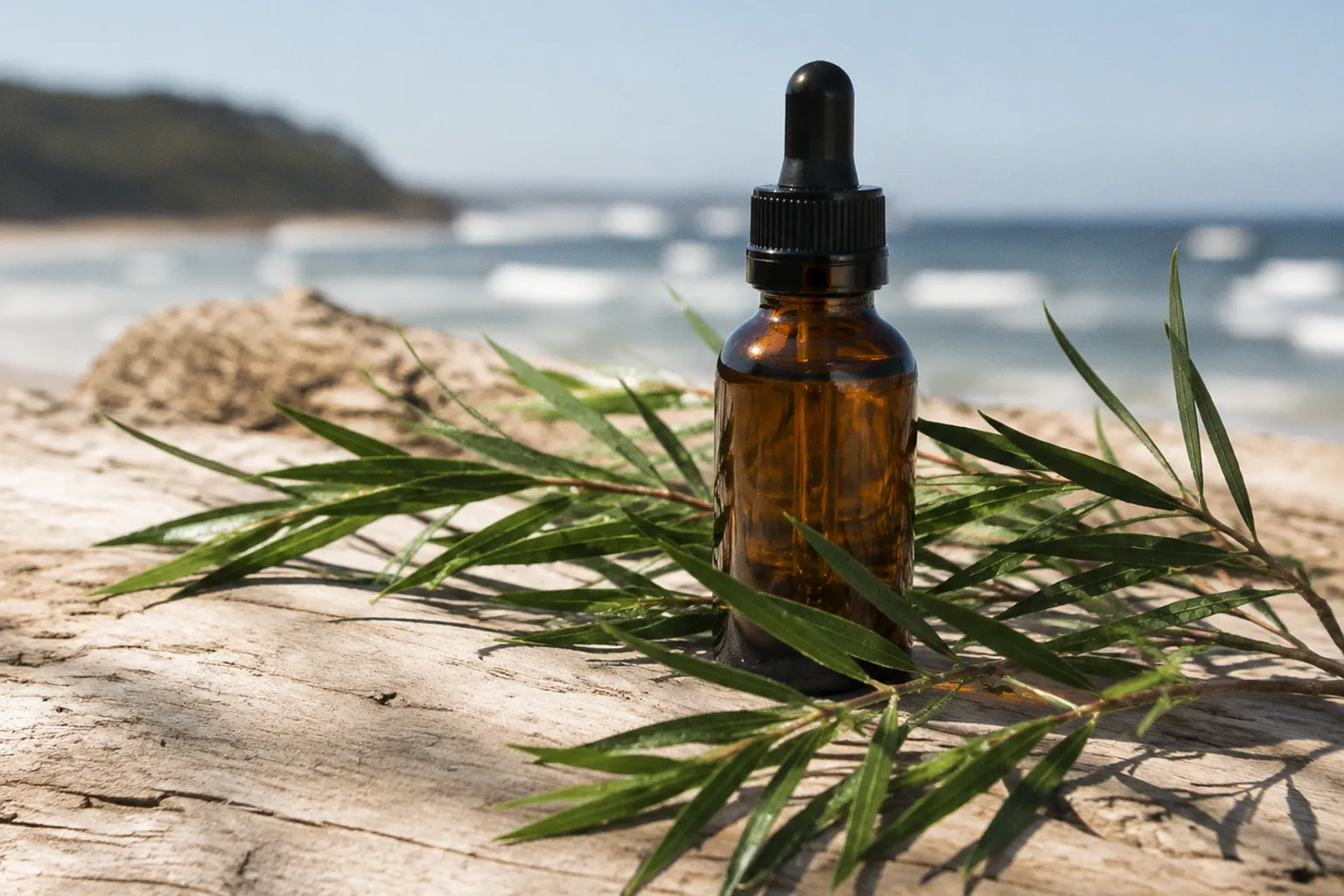
A pure, undiluted drop on a swollen papule can produce a red, tight, sometimes blistered patch within hours—an irritation that looks more aggressive than the blemish it was meant to treat.
The problem is not that tea tree oil has no place in blemish care. It is that raw essential oil is being handled like a finished skincare product. Those are different things, with different rules.
If you are applying tea tree oil directly to pimples, the short answer is no: do not use it undiluted on facial skin. A properly diluted tea tree oil spot treatment can be considered, but concentration, freshness, patch testing, and the condition of your skin barrier all matter.
The Risks of Undiluted Application: Why Pure Oil Can Backfire
Pure tea tree oil is a volatile, highly concentrated blend of terpene alcohols and hydrocarbons. Two of its most discussed constituents are terpinen-4-ol and 1,8-cineole. They contribute to the oil’s antimicrobial and aromatic profile, but in their concentrated form they can also be harsh on facial skin.
The irritation pathway is not mysterious. Essential oil compounds can penetrate the upper layers of the skin quickly. On a healthy, intact area, that may register as temporary stinging. On an inflamed pimple—especially one that has been squeezed, picked, or rubbed—the same exposure can produce a much stronger response.
The first signs are often burning or persistent stinging, followed by redness, tightness, dryness, peeling, or itching. More pronounced reactions can include swelling, small blisters, or contact dermatitis. These symptoms are not evidence that the tea tree oil is working harder. They are evidence that the skin is objecting.
A blemish already involves local inflammation and a compromised microenvironment. Adding an irritant can increase redness around the lesion and make the spot appear larger. It can also damage the surrounding barrier, causing the area to lose water more readily and become more reactive to the rest of the routine. Cleansers, exfoliating acids, retinoids, and even sunscreen may suddenly sting where they did not before.
This is why an undiluted tea tree oil skin reaction is easy to misread. The pimple may look drier for a short time, but the surrounding skin can be inflamed at the same time. A crusted or peeling lesion is not automatically a healthier lesion. In some cases, the irritation simply adds a second problem to the first one.
Concentration is the dividing line. Essential oils are not designed to be used on the face at full strength, and facial skin is particularly vulnerable around the nose, mouth, and eyes. The closer the application gets to those areas, the less room there is for experimentation.
There is also the question of oxidation. Tea tree oil changes as it is exposed to air, light, and heat. An opened bottle stored for a long time may become more likely to trigger sensitisation, even if its scent still seems familiar. Oxidised oil is not made safer by the fact that it remains natural or botanical. “Natural” describes the source, not the irritation potential.
Keep the bottle tightly closed and stored according to the product instructions, away from heat and direct light. Do not use an old bottle on damaged skin simply because there is still some left. The cost of replacing a small bottle is lower than the cost of nursing a preventable dermatitis flare.
Pure tea tree oil is a raw active ingredient, not a leave-on treatment. Treat it like one.
The same caution applies to products that combine tea tree oil with other essential oils, fragrance, cooling ingredients, or exfoliating acids. If a reaction develops, it becomes difficult to tell which ingredient caused it. A simple formula is easier to assess than a crowded one.
Understanding Terpinen-4-ol: The Science Behind the Botanical Power
The reason tea tree oil continues to appear in conversations about acne is terpinen-4-ol, a terpene alcohol that is commonly present in substantial amounts in quality tea tree oil. It is one of the constituents associated with the oil’s antimicrobial and anti-inflammatory activity.
In laboratory and clinical contexts, tea tree oil has been investigated for its effects on microorganisms associated with acne, including Cutibacterium acnes, as well as on the inflammatory response that gives a papule or pustule its redness and tenderness. That does not make tea tree oil a universal acne treatment, but it does explain why a carefully formulated product can do more than simply dry the surface of a blemish.
The important distinction is between the activity of the ingredient and the safety of the delivery system. A compound can be useful at one concentration and irritating at another. Skincare is full of examples of this principle: acids, retinoids, peroxide, and essential oils can all become counterproductive when the dose exceeds what the skin can tolerate.
Clinical research has found that a 5% tea tree oil preparation can be comparable with 5% benzoyl peroxide for reducing acne lesions over several weeks. Comparable does not mean identical, and it does not mean that a drop of pure essential oil is equivalent to a tested 5% formulation. The research applies to a measured, formulated product—not to a bottle of undiluted oil used as an improvised treatment.
Benzoyl peroxide and tea tree oil also behave differently in a routine. Benzoyl peroxide is a well-established acne active with a more direct oxidising action, while tea tree oil offers a botanical approach that some people find easier to tolerate when correctly formulated. Tea tree oil may feel slower, and a slower response can be mistaken for no response at all.
| Parameter | 5% Tea Tree Oil Preparation | 5% Benzoyl Peroxide |
|---|---|---|
| Primary active | Tea tree oil, including terpinen-4-ol | Benzoyl peroxide |
| Main role in acne care | Antimicrobial and anti-inflammatory support | Antimicrobial acne treatment |
| Expected pace | Gradual change over several weeks | May appear faster for some lesions |
| Common tolerance issues | Stinging, redness, dryness, sensitisation | Dryness, peeling, irritation, burning |
| Main practical caution | Must be formulated or diluted carefully; patch test first | Can be drying and may bleach fabrics |
| What the evidence does not support | Applying pure oil directly to the face | Assuming a stronger product is automatically better |
The table is useful for one reason: it keeps the comparison honest. A 5% tea tree preparation is not the same thing as “tea tree oil” in the abstract, and neither product guarantees clear skin. Acne is influenced by oil production, follicular plugging, inflammation, hormones, skin picking, product choice, and individual sensitivity. A spot treatment addresses only part of that picture.
Tea tree oil is therefore best understood as a targeted option for occasional inflammatory blemishes, not as a complete routine by itself. If breakouts are widespread, painful, recurrent, or leaving scars, relying on botanical tea tree oil blemish care alone may delay more appropriate treatment.
Mastering the 5% Dilution Ratio for Safe Spot Treatment
The tea tree oil spot treatment dilution for acne is a matter of concentration, not intuition. Adding “just a little” to a carrier oil is not a reliable method because drops vary in size and the final percentage depends on the total volume.
A commonly used facial dilution is about one drop of tea tree oil to twenty drops of carrier oil, producing approximately a 5% blend. It is better to treat 5% as an upper boundary for a home spot treatment rather than a target that every skin type must reach. Sensitive, dry, rosacea-prone, or already irritated skin may need a lower concentration—or may not tolerate tea tree oil at all.
In practical terms:
- 1 drop of tea tree oil + 20 drops of carrier oil gives an approximate 5% dilution.
- 2 drops of tea tree oil + 40 drops of carrier oil gives roughly the same concentration in a larger batch.
- 1 drop of tea tree oil + 30 drops of carrier oil creates a milder blend of approximately 3%, which may be a more sensible starting point for reactive skin.
The ratio is approximate because drop size is not standardised across bottles. A measured formulation is more accurate than counting drops, particularly if you are making a product intended for repeated use. If you cannot mix the concentration consistently, a pre-formulated tea tree product from a reputable skincare brand is usually the more controlled option.
Going above 5% does not make the spot treatment automatically more effective. It mainly reduces the margin between a potentially useful concentration and one that provokes redness, peeling, or sensitisation. Acne rarely improves because the skin was pushed harder. More often, the routine becomes harder to continue.
Choosing the carrier
The carrier oil is not just filler. It changes how the tea tree oil spreads, how quickly the blend feels absorbed, and how much of the concentrated essential oil reaches any one area at once.
Jojoba, squalane, and fractionated coconut oil are commonly considered for lightweight facial blends. Jojoba has a texture that many people find compatible with facial skin. Squalane is light and generally comfortable for dry or reactive-feeling skin. Fractionated coconut oil spreads easily and remains fluid, although individual tolerance still matters.
The word “non-comedogenic” is not a guarantee that a product will suit everyone. Acne-prone skin can react to a perfectly reasonable ingredient, especially when the face is already irritated. Start with a small amount, keep the formula simple, and do not combine the tea tree oil with several new ingredients at the same time.
For a first attempt, avoid a carrier blend that already contains fragrance, cooling agents, exfoliating acids, retinoids, or other essential oils. If the skin reacts, a simple formula gives you a better chance of identifying the cause.
Mixing and applying the blend
Make only a small amount and keep it in a clean, dark container with a secure lid. A diluted blend should not sit for months in a half-full bottle. The more air in the container and the longer it is stored, the less confidence you can have in its freshness.
A careful application looks like this:
1. Cleanse with a gentle cleanser and pat the skin dry. Do not apply the blend to wet, sweating, freshly exfoliated, or freshly shaved skin.
2. Prepare or dispense a small amount of the diluted blend using clean hands or a clean cotton swab.
3. Apply a tiny amount to the blemish itself, keeping the surrounding skin as untouched as possible.
4. Keep the product away from the eyelids, lips, nostrils, and any cracked or open skin.
5. Wash your hands after application, even if the amount used was small.
6. Begin with once-daily use rather than applying it repeatedly throughout the day.
7. Stop if the area becomes increasingly red, hot, itchy, swollen, or painful.
There is no advantage in soaking a cotton swab or covering a spot in oil. The goal is a controlled, thin application. More product mostly means more opportunity for irritation.
Layering matters as well. Applying tea tree oil over a freshly used retinoid, alpha hydroxy acid, beta hydroxy acid, strong vitamin C product, scrub, or benzoyl peroxide can make an already active routine considerably harsher. If you use several acne ingredients, place them in separate routine slots or simplify the routine while assessing the tea tree product. Waiting a few minutes does not always eliminate the possibility of irritation; the bigger issue is the total load on the same patch of skin.
The Essential Patch Test: Protecting Your Skin Barrier Before Application
Even at a properly diluted concentration, tea tree oil is an active ingredient rather than a moisturiser. A patch test is especially important for anyone with eczema, dermatitis, fragrance sensitivity, a history of reactions to essential oils, or a currently damaged skin barrier.
Prepare the exact dilution you intend to use. Apply a small amount to an inconspicuous area such as the inner elbow or behind the ear. Do not apply it to broken skin, and do not cover the area unless the product instructions specifically require that. Observe the site over the next 24 to 48 hours.
A calm patch test does not guarantee that the face will tolerate the product, but it is useful information. Facial skin may still respond differently because it is exposed to cleansing, sun, sweat, shaving, and other skincare products. If the patch test is completely uneventful, the next step should be one small facial lesion—not a full-face application.
Watch for:
- Redness that persists rather than fading shortly after application.
- Burning, itching, or pronounced tingling.
- Swelling, hives, or clusters of small bumps.
- Dryness, scaling, or peeling at the test site.
- Blisters, oozing, or a weeping reaction.
A reaction that appears immediately may reflect irritation, while a delayed itchy rash can be consistent with contact sensitisation. You do not need to diagnose the difference at home to take it seriously. Rinse the area with cool water and a mild cleanser, stop using the product, and avoid applying tea tree oil to the face.
Do not try to overcome a reaction by diluting the product further and applying it repeatedly. Once the skin has shown clear signs of sensitisation, continued exposure can make future reactions more likely or more severe. Essential oils are not harmless simply because they are plant-derived.
If the patch test remains quiet, apply the diluted blend to one blemish and leave the rest of the routine unchanged. This is a more useful test than introducing the product alongside a new cleanser, serum, mask, and exfoliant. If irritation appears, you will know where to look.
A patch test is not optional paperwork—it is the step that keeps a botanical active from becoming a botanical burn.
The skin barrier also determines whether this is a good time to test tea tree oil. Delay the experiment if the face is peeling from a retinoid, tight after over-cleansing, sunburned, freshly waxed, or covered in open acne lesions. A product that might be acceptable on stable skin is a poor choice for skin already asking for less.
Managing Expectations: Why Botanical Care Requires Patience
The most common reason people abandon tea tree oil is that the first few days do not match the expectation created by a strong-smelling essential oil. The scent is intense, the product feels active, and the user expects a pimple to flatten overnight. Skin does not necessarily follow that schedule.
A properly diluted tea tree treatment is not supposed to cauterise a blemish. Any useful effect is more likely to appear gradually as reduced redness, less tenderness, or a shorter inflammatory phase. Clinical research on 5% preparations assessed change over several weeks, not after a single application.
Give the routine enough time to be judged, but not so much time that you ignore a bad reaction. Those are separate questions. Slow improvement can justify patience; burning, swelling, or a spreading rash does not.
In practice:
- Start with one small area and once-daily application.
- Reassess after several weeks rather than expecting a result the next morning.
- Do not increase the concentration or frequency simply because the first few days feel underwhelming.
- Look first for reduced swelling and tenderness, not instant disappearance.
- Keep the rest of the routine simple and barrier-supportive.
- Use sunscreen in the morning, particularly if the area is peeling or healing.
A basic routine around a tea tree spot treatment might include a gentle cleanser, a plain moisturiser, and daily broad-spectrum sunscreen. The point is not to build an elaborate botanical system. It is to prevent the surrounding skin from becoming dry and reactive while the blemish settles.
The treatment also needs to fit the type of acne. A single occasional papule is a reasonable context for a carefully diluted spot treatment. A field of clogged pores, repeated jawline breakouts, deep tender nodules, or acne that is leaving pits and persistent marks requires a broader plan. Tea tree oil cannot correct every process that contributes to acne, and using it over a wide area increases exposure without necessarily improving the result.
When the routine goes wrong
If irritation starts within minutes, the concentration may be too high, the skin may already be compromised, or the formula may contain another irritating ingredient. Rinse the area, stop the product, and allow the barrier to recover rather than trying to neutralise the problem with another active.
If there is no visible improvement after several weeks, check the basics before making the blend stronger. Is the oil old or poorly stored? Is the blemish being picked? Are several other actives causing background irritation? Is the acne too widespread for a spot treatment to address? A lack of progress does not automatically mean that more tea tree oil is needed.
If the patch test produces dermatitis, tea tree oil is not a suitable active for your skin at that point. There are other acne ingredients, including azelaic acid and benzoyl peroxide, but switching should be done carefully and according to your skin’s tolerance. Adding a new treatment immediately after a reaction makes the next cause harder to identify.
If the pimple dries but leaves a dark or red mark, that is not unusual. Inflammation and picking can contribute to post-inflammatory marks, and a spot treatment does not automatically prevent them. Gentle handling, moisturising, and consistent sun protection matter more than repeatedly drying the lesion.
If the scent causes headache, nausea, or general discomfort, discontinue the product. There is no skincare benefit worth forcing yourself to tolerate a volatile fragrance profile.
If you use retinoids or exfoliating acids, consider keeping tea tree oil out of the same routine slot. Separating actives reduces the chance of turning a small blemish into a large irritated patch, although separation cannot make an unsuitable product suitable.
Tea tree oil can be a legitimate botanical active when it is present in a controlled formula or diluted carefully and used on stable skin. It should not be applied directly from the bottle to a pimple. The practical difference is not marketing language or a stronger sensation on the skin; it is the concentration.
Use a measured tea tree oil carrier oil ratio for acne, patch test before facial use, keep the blend fresh, and give a mild routine several weeks to show what it can do. If the skin burns, swells, or peels, stop. A blemish may be temporary, but a damaged barrier can keep the entire routine unsettled long after the original pimple has gone.