Botanical spot treatments vs hydrocolloid patches for acne
The mechanism behind hydrocolloid patches and botanical spot treatments diverges at the level of polymer chemistry. Hydrocolloid dressings manage what is already present on the skin surface.
Jude Carstairs·Updated: September 20, 2026·9 min read
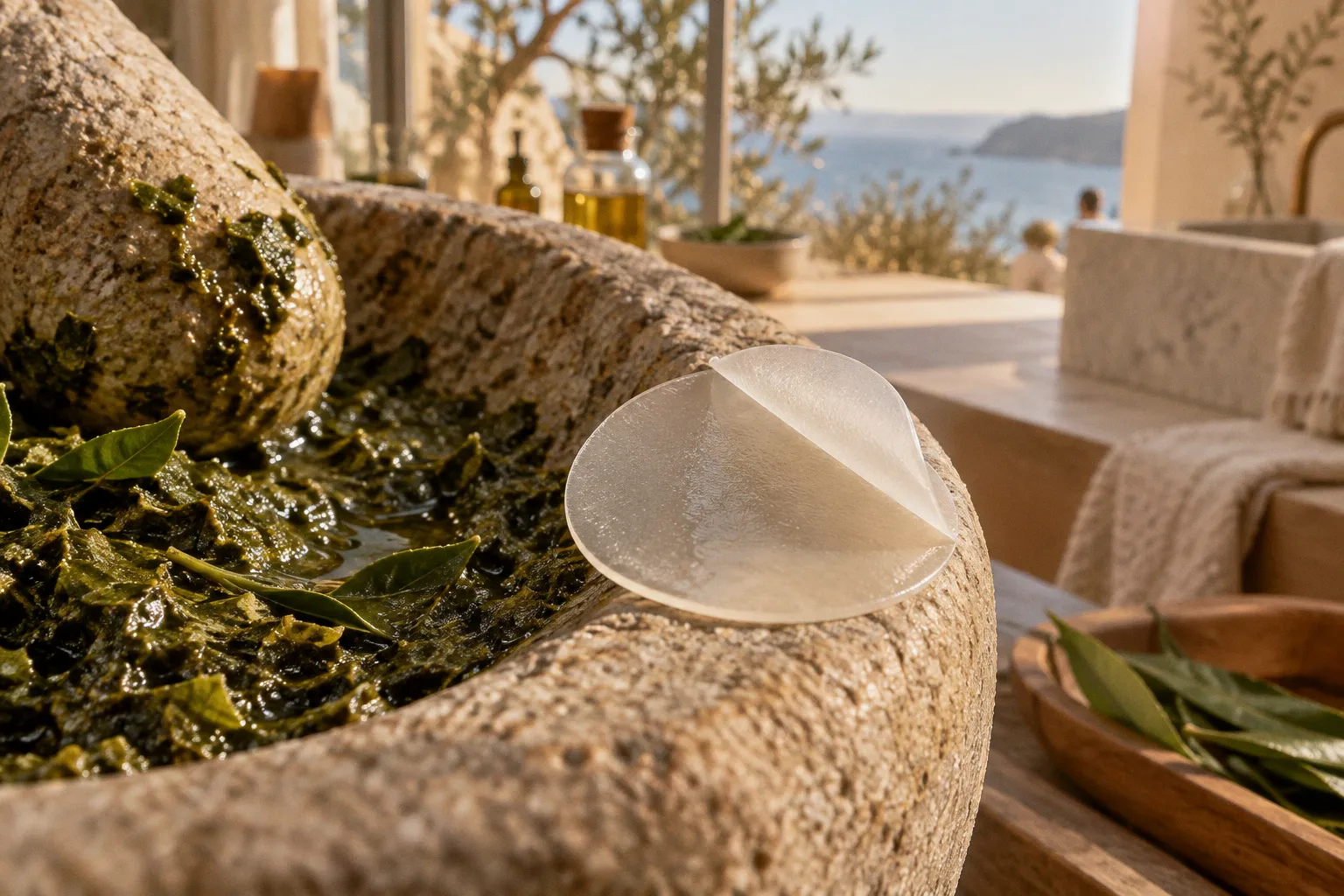
Two Mechanisms, One Lesion: Why These Treatments Cannot Be Substituted
Botanical actives are formulated to modify conditions within the pilosebaceous unit. The most common consumer misconception — that a single adhesive patch can resolve a deep inflammatory lesion — collapses the moment the ingredient list is examined. Sodium carboxymethylcellulose, pectin, and gelatin, the gel-forming agents in the majority of retail hydrocolloid patches, swell in response to surface moisture. They do not generate negative pressure. They do not traverse intact epidermis. They do not reach a deep cystic nodule.
This is not a marginal distinction. It is a categorical one. The Australian skincare market stocks both product classes in abundance, and consumer-facing literature routinely treats them as interchangeable. They are not. The table below summarises the structural differences.
| Parameter | Hydrocolloid patch | Botanical spot treatment |
|---|---|---|
| Primary mechanism | Physical absorption of surface exudate | Topical delivery of bioactive compounds |
| Active penetration into skin | None | Percutaneous absorption into upper follicle |
| Effective lesion stage | Open or surfacing blemishes only | Closed comedones through early pustules |
| Effect on sebum production | None | Variable, depending on active (niacinamide, salicylic acid) |
| Effect on C. acnes | None direct | Tea tree oil, salicylic acid demonstrate activity |
| Risk when misapplied | Adhesive irritation on intact skin | Chemical irritation under occlusion |
| Typical format | Adhesive polymer matrix | Liquid, gel, or emulsion in targeted applicator |
The two categories occupy different positions in the acne-management sequence. Treating them as direct substitutes produces predictable failure modes.
Hydrocolloid Chemistry and Function
The hydrocolloid patch is a medical-grade wound-care format. It was developed for the management of low-exudate wounds and adapted for cosmetic retail. The construction is consistent across most products on the Australian market: a gel-forming polymer layer laminated to a semi-permeable polyurethane outer film.
Polymer composition
The inner matrix typically contains one or more of the following: pectin, a polysaccharide that gels in the presence of cations; gelatin, a partially hydrolysed collagen derivative; and sodium carboxymethylcellulose, a cellulose ether with high water-binding capacity. When the patch contacts a moist surface — an open pustule, an expressed whitehead, a weeping lesion — the matrix absorbs the fluid and swells. The outer film remains impermeable to liquid and most bacteria, which produces the secondary benefit of contamination control.
A hydrocolloid patch is a wound dressing in a cosmetic wrapper. Its function is to manage exudate that has already reached the skin surface.
What it does not do
The constraints of the format are non-negotiable. A standard hydrocolloid patch:
- Does not penetrate the stratum corneum. The polymer matrix sits on top of the skin.
- Does not deliver any bioactive compound into the follicle.
- Does not influence keratinocyte desquamation, sebum viscosity, or microbial proliferation.
- Cannot resolve a blind pimple or deep cystic nodule, because there is no exudate present at the surface to absorb.
- Does not alter the underlying biochemistry that produced the blemish.
The "drawing out" claim associated with hydrocolloid has no basis in polymer chemistry. The matrix absorbs along the existing moisture gradient. It cannot establish one where none exists.
Botanical Spot Treatment Pharmacology
Botanical spot treatments are topical delivery systems. They deposit concentrated actives onto the lesion, where percutaneous absorption carries the compounds into the upper follicle and the surrounding dermal tissue. The objective is biochemical correction of the acnegenic environment.
The actives most commonly used in Australian-market formulations can be grouped by mechanism.
Keratolytics
Salicylic acid (BHA) is the reference compound. At 0.5–2% concentration, it is lipid-soluble, which allows it to penetrate the sebum-filled follicular canal. Its mechanism is the disruption of intercellular corneocyte adhesion in the stratum corneum and the infundibulum, reducing the hyperkeratinised plug that initiates comedone formation. Botanical alternatives include fruit enzyme complexes (papain, bromelain) at 1–5%, which degrade keratin via proteolytic action.
Antimicrobials
Tea tree oil (Melaleuca alternifolia) contains terpinen-4-ol as its principal bioactive. At concentrations above 5%, terpinen-4-ol demonstrates measurable activity against Cutibacterium acnes in vitro. Standard consumer formulations sit in the 5–10% range, diluted in a non-comedogenic carrier. Australian formulations occasionally substitute or blend with lemon myrtle (Backhousia citriodora) and eucalyptus (Eucalyptus globulus) leaf oil, both of which contain citral and 1,8-cineole respectively — compounds with documented but less extensively characterised antibacterial profiles.
Anti-inflammatory and barrier-modulating
Niacinamide (vitamin B3) at 4–10% inhibits melanosome transfer from melanocytes to keratinocytes, reducing the post-inflammatory hyperpigmentation that frequently follows blemish resolution. It also suppresses the release of pro-inflammatory cytokines from keratinocytes, addressing the inflammatory component of acne without the irritation profile of higher-strength acids.
| Active | Primary mechanism | Typical concentration |
|---|---|---|
| Salicylic acid | Lipid-soluble keratolytic | 0.5–2% |
| Tea tree oil | Terpinen-4-ol antibacterial/anti-inflammatory | 5–10% |
| Niacinamide | Melanin transfer inhibition, anti-inflammatory | 4–10% |
| Sulfur | Keratolytic, antimicrobial | 3–10% |
| Lactic acid | Water-soluble exfoliant | 5–10% |
| Fruit enzymes (papain/bromelain) | Proteolytic keratin degradation | 1–5% |
Each of these targets a specific variable in acne pathogenesis. The format is not interchangeable with a passive absorbent dressing.
The Occlusion Problem
A persistent consumer practice involves layering: applying a botanical spot treatment and immediately sealing it with a hydrocolloid patch. The assumption is that the occlusive layer will drive the active deeper into the skin. The actual outcome is concentration amplification, not enhanced delivery.
Occlusion traps the applied active against the skin surface and prevents evaporative loss. The stratum corneum absorbs more of the compound than it would under ambient conditions. For most actives, this exceeds the intended dosing range.
The risk profile varies by active:
- Salicylic acid at 2% and above under occlusion: elevated transepidermal absorption, increased erythema and peeling risk
- Benzoyl peroxide under occlusion: oxidation accelerated, potential chemical burn on compromised skin
- Tea tree oil at high concentration under occlusion: sensitisation risk amplified by sustained contact
- Niacinamide: generally tolerated, minimal irritation signal under occlusion
The danger is highest when the lesion itself has compromised the skin barrier. An open pustule, a recently expressed whitehead, or any area where the epidermis is broken will absorb the active at a substantially higher rate under an occlusive dressing. This is the documented mechanism behind the irritation reports associated with hydrocolloid-layered actives.
Occlusion does not amplify efficacy. It amplifies concentration. Those two outcomes are not equivalent.
If the goal is to combine absorbent physical action with topical delivery, the engineered option is the hybrid patch — not improvised layering.
Matching the Intervention to the Lesion Stage
Effective blemish management follows the lesion through its morphological stages. Each stage has a different biochemical and structural profile, and the intervention must match.
Stage 1: Closed comedone or early papule
The follicular plug is forming or has formed. No exudate is present. The skin surface is intact.
Intervention: Botanical spot treatment. Salicylic acid or a botanical keratolytic alternative is the appropriate choice. Hydrocolloid is non-functional at this stage — the polymer has no exudate to absorb, and the adhesive can irritate undisturbed skin.
Stage 2: Inflammatory papule or pustule forming a head
The lesion is raised, erythematous, and approaching the surface. Bacterial activity and inflammatory cascade are active.
Intervention: Continued botanical spot treatment, with emphasis on anti-inflammatory actives — niacinamide, moderate-concentration tea tree oil. Manual interference must be avoided.
Stage 3: Open or partially expressed whitehead or pustule
The lesion has surfaced. Exudate is present or emerging. This is the point of highest risk for manual interference and secondary infection.
Intervention: Hydrocolloid patch. The matrix absorbs exudate, the film prevents contact contamination, and the physical barrier reduces picking — the single most common driver of post-inflammatory hyperpigmentation.
Stage 4: Post-resolution
The lesion has resolved. Residual erythema or pigmentary change is the remaining concern.
Intervention: Botanical spot treatment with niacinamide as the primary active. Hydrocolloid has no remaining role.
The failure mode in most consumer routines is the application of one product type across all four stages. The skin does not work that way. Lesion morphology determines intervention, not brand preference or product familiarity.
Hybrid Patches: Engineering the Combination
Hybrid patches integrate hydrocolloid's absorbent matrix with botanical or medicinal actives laminated into the adhesive layer. The objective is to deliver physical exudate management and topical bioactive action in a single format.
Common configurations on the Australian market:
- Hydrocolloid + tea tree oil: pectin-based matrix infused with Melaleuca alternifolia extract at sub-irritant concentrations (1–3% of the topical layer)
- Hydrocolloid + salicylic acid: low-dose BHA (0.5%) integrated into the polymer film
- Hydrocolloid + niacinamide: niacinamide-impregnated matrix targeting residual erythema
- Hydrocolloid + aloe vera or Centella asiatica: anti-inflammatory botanical infusion aimed at mitigating occlusion-induced irritation
- Microneedle or micro-dart patches: dissolvable polymer arrays that deliver actives directly into the upper epidermis — a categorically different delivery class
The clinical question is whether the active concentration delivered through the patch matrix reaches a pharmacologically meaningful threshold. In most retail formulations, the answer is marginal. The actives are present at doses sufficient to support mild antimicrobial and barrier-maintenance action, but insufficient to clear a stubborn inflammatory papule independently. The hydrocolloid component remains the primary intervention; the botanical component is adjunctive.
This is not a criticism of the format. It is a clarification of its mechanism. Consumers using hybrid patches should understand that the absorbent dressing is doing the structural work, and the botanical infusion is supplementing rather than replacing the active treatment.
The Verdict on Efficacy
Hydrocolloid patches and botanical spot treatments are not competitors. They are sequential interventions matched to different stages of the same pathological process.
The evidence supports the following conclusions:
1. Hydrocolloid is effective for surface-level blemishes that have expressed or are expressing exudate. Its mechanism is physical absorption, not biochemical correction. It does not alter sebum production, does not influence keratinisation, and does not reach subdermal inflammation.
2. Botanical spot treatments are effective for closed comedones, inflammatory papules, and early-stage lesions where follicular biochemistry is the active variable. Their mechanism is percutaneous delivery of keratolytic, antibacterial, and anti-inflammatory compounds.
3. Simultaneous application of a potent botanical active and a hydrocolloid patch on broken or compromised skin introduces an unnecessary irritation risk. The occlusion concentrates the active rather than enhancing its delivery.
4. Hybrid patches reduce the layering risk by integrating the combination at the formulation stage. The botanical component in most retail hybrids delivers sub-clinical doses relative to standalone spot treatments.
For an Australian consumer managing active acne with botanical formulations, the operational protocol is straightforward. Apply a botanical spot treatment during the closed and inflammatory stages, with salicylic acid or tea tree oil as the primary actives. Switch to a standard hydrocolloid patch once the lesion has surfaced and exudate is present. Return to a botanical spot treatment — niacinamide as the preferred active — during the post-resolution phase to manage residual pigmentation.
This sequence is not a single-product miracle, and it will not be marketed as one. It is, however, consistent with what the polymer chemistry and the pharmacological mechanism actually do — which is the only standard that produces reliable outcomes.