Botanical Antioxidant Serums: How to Choose the Right Base
The botanical antioxidant serum market runs on a default assumption: water-based equals lightweight and oil-based equals comedogenic. Both halves of that statement are oversimplifications.
Jude Carstairs·Updated: September 06, 2026·9 min read
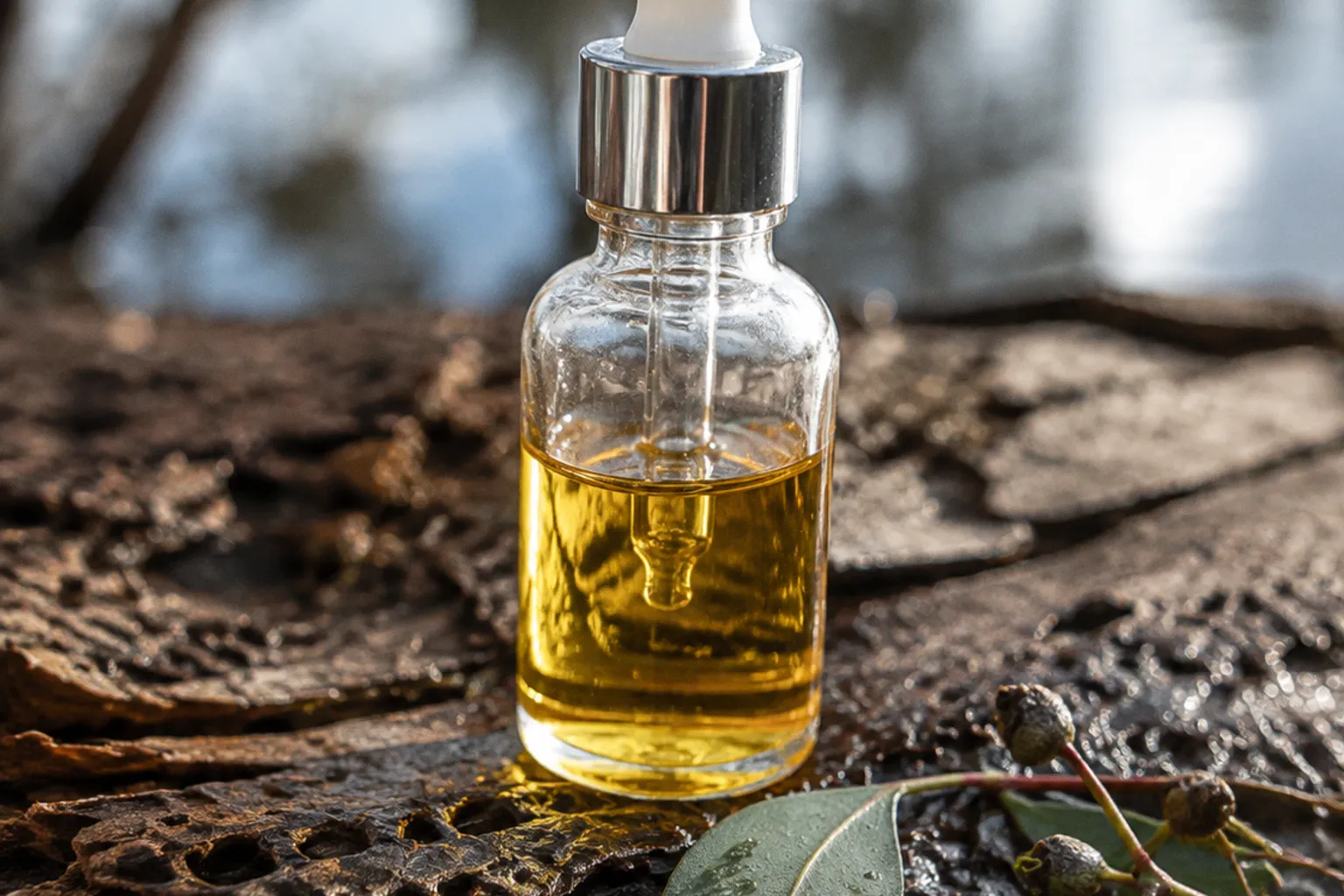
The actual choice between an aqueous serum and an anhydrous lipid serum depends on three measurable factors: the solubility profile of the active ingredient, the molecular weight of the compound being delivered through the stratum corneum, and the lipid status of the skin at the moment of application. Texture is the last variable to consider, not the first.
The Chemistry of Aqueous vs. Anhydrous Formulations
A water-based serum uses water or aloe vera juice as its primary solvent. INCI declarations list aqua — or "aloe barbadensis leaf juice" in botanical-leaning brands — as the first ingredient. This aqueous matrix can only solubilize hydrophilic active ingredients: molecules with sufficient polarity to remain dissolved in water. The list includes L-ascorbic acid (vitamin C in its pure form), niacinamide (vitamin B3), low-molecular-weight hyaluronic acid, certain peptide sequences, and most fruit-derived alpha hydroxy acids at low concentrations.
An oil-based serum contains little to no water. Its solvent system consists of plant-derived carrier oils or synthetic lipids — rosehip seed oil, argan oil, jojoba oil, squalane — which deliver lipophilic (fat-soluble) compounds. This includes tocopherol (vitamin E), carotenoids (beta-carotene, astaxanthin), resveratrol, CoQ10, and fat-soluble polyphenols such as those extracted from rosemary leaf or turmeric rhizome.
The distinction is structural, not cosmetic. It dictates which molecules a formula can carry, how the product resists microbial spoilage, and how it interfaces with the intercellular lipids of the stratum corneum.
Solubility is the binding constraint. Choosing a base that cannot solubilize the target active renders the formulation inert regardless of ingredient sourcing or marketing claims.
How Water-Based Serums Deliver Active Botanicals
Water-based serums function as delivery systems for polar compounds. The mechanism is straightforward: an aqueous vehicle carries a dissolved active to the surface of the skin, where the active partitions into the stratum corneum or penetrates through intercellular channels depending on its molecular weight.
L-ascorbic acid is the most documented example. In its pure form, it dissolves readily in water but not in oil. Its molecular weight (176.12 g/mol) and hydrophilic profile mean it cannot cross the lipid-rich domains of the stratum corneum efficiently without a water-rich vehicle to keep it in solution during application. A water-based serum at a pH below 3.5 keeps L-ascorbic acid protonated and stable; the same active in an anhydrous base would not remain dissolved and could not deliver a consistent concentration per drop.
Niacinamide behaves similarly. It is water-soluble, heat-stable, and works across a broader pH range than L-ascorbic acid (typically 5.0–7.0). This makes it easier to formulate but does not change the underlying constraint: it requires water as its carrier.
The limitation of water-based serums is also structural. An aqueous formula does not contain occlusive lipids. Without an emollient layer — a moisturizer or facial oil applied over it — water evaporates from the skin surface and transepidermal water loss increases rather than decreases. This is not a flaw in the product. It is the direct consequence of removing lipids from the formula. The serum is designed to deliver; the moisturizer is designed to seal.
The Role of Lipid Carriers in Oil-Based Antioxidant Serums
Oil-based serums operate through a different mechanism. The lipid vehicle carries fat-soluble antioxidants into the outer layers of the stratum corneum, where they integrate with the skin's own intercellular lipids. Carrier oils selected for botanical antioxidant serums are typically chosen for their fatty acid profile: linoleic acid-rich oils (rosehip seed, evening primrose) for barrier support, oleic acid-rich oils (argan, marula) for emolliency, and squalane for structural similarity to human sebum.
The antioxidant payload in an oil-based serum is generally distinct from a water-based one. Vitamin E (tocopherol) is lipophilic and unstable in aqueous solution; it requires an oil base. Carotenoids oxidize rapidly in the presence of water and oxygen; lipid carriers limit this exposure. Polyphenols extracted from botanicals like green tea or rosemary often partition into the lipid fraction during extraction and are preserved there because the solvent matches their solubility.
The lipid base is not inert filler. It is the structural component that determines whether a fat-soluble antioxidant can reach the stratum corneum at all.
A secondary function of the lipid base is occlusivity. The carrier oil forms a thin film that limits transepidermal water loss. For dry or mature skin with a compromised lipid barrier, this is the more mechanically relevant function. For acne-prone skin, it is the source of legitimate concern — though the concern is not about oils in general but about specific oils with high comedogenic ratings applied to skin already experiencing follicular occlusion. Light non-comedogenic lipids like squalane and jojoba esters have comedogenicity ratings of 0–2 on standard scales and behave differently from coconut oil, which sits at 4.
| Parameter | Water-Based Serum | Oil-Based Serum |
|---|---|---|
| Primary solvent | Aqua or aloe leaf juice | Carrier oil (rosehip, argan, jojoba, squalane) |
| Active solubility | Hydrophilic (L-ascorbic acid, niacinamide, peptides) | Lipophilic (tocopherol, carotenoids, resveratrol) |
| Preservative system | Required (microbial growth substrate) | Not required (anhydrous) |
| Barrier interaction | Delivers active; does not occlude | Integrates with intercellular lipids; occludes |
| pH range | Often 3.0–5.5 depending on active | Not applicable (no aqueous phase) |
| Oxidation risk | L-ascorbic acid turns yellow/orange in water | Unsaturated fatty acids turn rancid over months |
| Typical skin fit | Oily, combination, acne-prone (with seal) | Dry, mature, lipid-depleted |
Stability Challenges: Why pH and Preservation Matter
Stability is where the two formulations diverge most sharply. Pure L-ascorbic acid oxidizes when exposed to water, air, heat, and light. In a water-based serum, this oxidation is visible: the formula turns yellow, then orange, then brown as the active degrades into dehydroascorbic acid and further breakdown products. To slow this process, formulators lower the pH — typically to below 3.5 — to keep the molecule protonated. The result is a stable but acidic product that can irritate sensitive or rosacea-prone skin.
Oil-based serums avoid this specific degradation pathway. Without water, L-ascorbic acid cannot be solubilized, so the formulation instead uses fat-soluble vitamin C derivatives (tetrahexyldecyl ascorbate, ascorbyl palmitate) or other lipophilic antioxidants. These derivatives are more stable in the lipid matrix but have different bioavailability profiles than pure L-ascorbic acid — they convert to ascorbic acid in the skin rather than arriving as ascorbic acid.
Preservation is the second axis. An aqueous formula requires a preservative system to prevent microbial growth — bacteria, yeast, and mold all proliferate in water-based environments. Common systems include phenoxyethanol, ethylhexylglycerin, and plant-derived options such as radish root ferment or leucidal liquid. An anhydrous oil-based serum requires no broad-spectrum preservative because there is no water available to support microbial metabolism. This is one of the cleanest formulation choices available in skincare: removing the water phase removes the primary substrate for contamination.
The tradeoff is shelf-life under other stress conditions. Lipid carrier oils oxidize over months, developing rancidity as unsaturated fatty acids react with oxygen. A well-formulated oil-based serum includes an antioxidant — frequently vitamin E itself — to slow this process, but the formulation is not indefinitely stable. Storage away from heat and direct sunlight is more critical for an anhydrous oil serum than for a water-based one because oxidation accelerates with temperature.
Strategic Layering: Sequencing Serums for Maximum Absorption
Layering water-based and oil-based serums in the same routine is technically feasible and often advisable. The sequence is non-negotiable: water-based first, lipid-based second.
The principle is straightforward. A water-based serum is formulated to deliver hydrophilic actives into an aqueous environment on the skin's surface. If an oil-based product is applied first, it creates a lipid film that the water-based serum cannot penetrate to deliver its active. Applied second, the oil-based serum functions as an occlusive seal, slowing water evaporation from the skin and extending the water-based active's contact time with the stratum corneum.
The recommended dose for either format is typically 2 to 3 drops or one full pump — enough to cover the face and neck with a thin layer that absorbs within one to two minutes. Over-application does not increase active delivery; it increases product waste and the risk of pilling under subsequent products.
For acne-prone skin, the layering decision becomes more specific. A water-based niacinamide or zinc PCA serum can be applied first, followed by a non-comedogenic lipid such as squalane or a low-comedogenic carrier oil like jojoba. Oils rated 0–2 on standard comedogenicity scales carry low risk of follicular occlusion when applied in small amounts over a water-based active. Higher-comedogenic oils (coconut, wheat germ, cocoa butter at full concentration) should not be layered over actives in this skin type.
For dry or mature skin with reduced lipid production, the layering can be reversed in priority: a lipid-rich serum goes on first or alone, followed by a richer emollient moisturizer to seal both layers and reduce evaporation overnight.
The Decision Matrix
The base of a botanical antioxidant serum is not a marketing preference. It is a structural constraint that determines which active can be delivered, how stable that active will remain in the bottle, and how the formula will interact with the skin's lipid and aqueous domains.
For oily, combination, or acne-prone skin seeking water-soluble antioxidants (L-ascorbic acid, niacinamide, low-molecular-weight hyaluronic acid), a water-based serum is the correct vehicle. The decision of whether to seal it with a non-comedogenic lipid depends on barrier status and ambient humidity.
For dry, mature, or lipid-depleted skin seeking fat-soluble antioxidants (tocopherol, carotenoids, lipophilic polyphenols), an oil-based serum is the correct vehicle. The carrier oil selection determines whether the formula supports barrier function or risks occluding follicles: squalane and jojoba for low comedogenicity; rosehip and argan for higher linoleic and oleic acid content respectively.
The misleading variable is texture. A serum that feels light is not necessarily delivering more active. A serum that feels rich is not necessarily occluding pores. The relevant data are solubility, stability, comedogenicity of the carrier, and the solubility profile of the active ingredient itself. Once those four parameters are fixed, the choice of base becomes a single-step calculation rather than a marketing decision.