Calming Face Mists: When and How to Apply Them
After cleansing, the stratum corneum can begin losing moisture within minutes. The lipid matrix that helps hold hydration in place has been disturbed by washing, and transepidermal water loss may…
Iris Ellingham·Updated: September 06, 2026·17 min read
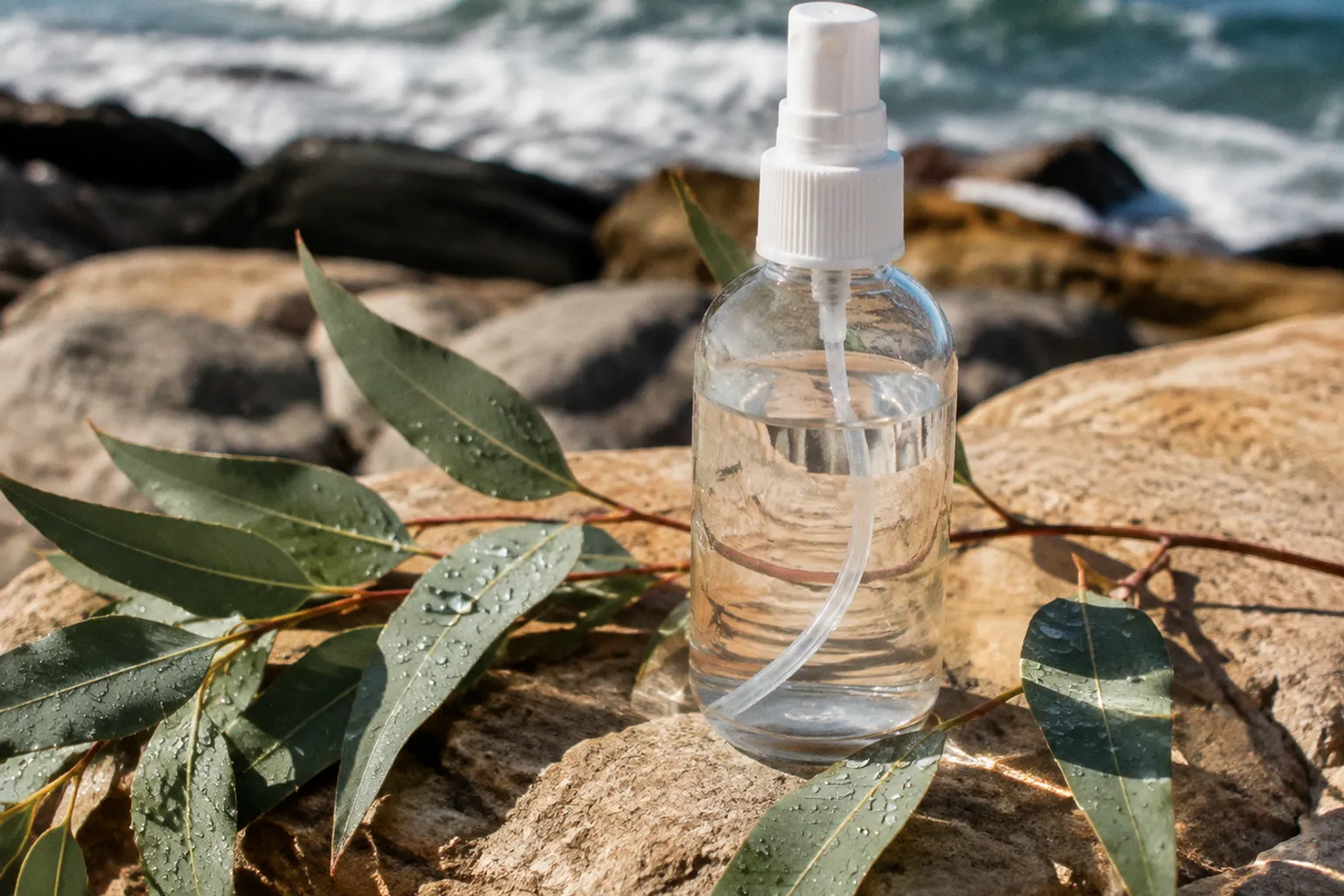
After cleansing, the stratum corneum can begin losing moisture within minutes. The lipid matrix that helps hold hydration in place has been disturbed by washing, and transepidermal water loss may increase just as the skin is most receptive to whatever comes next. A calming facial toning mist formulated with the right humectants and bioactives — chamomile’s bisabolol to soothe the appearance of redness, Centella asiatica compounds to support the skin barrier, or green tea polyphenols to help buffer oxidative stress — can slow that loss and prepare the skin for the next layer.
The catch is formulation. Plain water can provide temporary hydration: fine water particles may increase water content in the stratum corneum, and the skin can feel immediately fresher after a spritz. But that effect is short-lived if the water evaporates without humectants or an occlusive layer to hold it in place. In dry air, repeated misting without follow-up skincare may even leave the skin feeling tighter.
Not every spray bottle on the shelf earns its place in a daily regimen. The difference between a mist that genuinely supports hydration and one that merely creates a fleeting wet sensation is decided at the ingredient level — and then by when and how it is applied.
The Science of Hydration: Why Mists Need Humectants
A facial mist is not automatically a moisturizer. Water on the surface can hydrate the outermost layer of the skin for a short time, but it does not necessarily remain there. As the droplets evaporate, the initial benefit fades. If the skin is already dry, the surrounding air is low in humidity, and there is no humectant or occlusive product to follow, evaporation can leave the surface feeling drier than it did immediately after spraying.
That does not make plain water useless. A fine mist can increase stratum-corneum water content and provide immediate comfort, especially when the skin feels hot or tight. The important distinction is between temporary surface hydration and sustained moisture retention. Water supplies the first; the rest of the formula and the following skincare determine whether the second is possible.
Humectants are the operative ingredient class in any credible mist. These molecules have a strong affinity for water and help bind it within or around the stratum corneum. Glycerin is the workhorse. Hyaluronic acid, a glycosaminoglycan with a strong water-binding capacity, supports a plumper, more hydrated surface. Sodium PCA, panthenol, betaine, and aloe vera are also common choices in well-balanced hydrating formulas.
A useful way to read a mist is to look for what happens after the spray lands. A water-only product wets the skin and then disappears. A humectant-rich product gives that water something to associate with. A moisturizer or facial oil applied afterward adds the occlusive step that slows evaporation. None of these layers needs to be heavy, but the sequence matters when the goal is more than a few seconds of coolness.
A calming formula may pair humectants with botanical extracts that contribute soothing phenolic compounds, flavonoids, or polysaccharides. Rose hydrosol contains water-soluble aromatic and phenolic compounds released during the steam distillation of Rosa damascena petals. It can give a formula a gentle botanical character without relying on the much more concentrated essential oil. Calendula extracts contribute polysaccharides and flavonoids associated with soothing formulations. German chamomile is valued for compounds such as chamazulene and bisabolol, while Roman chamomile has a different aromatic profile, richer in esters.
The presence of a botanical does not automatically make a mist suitable for reactive skin. Extract quality, concentration, preservation, fragrance components, and the overall formula all matter. Even a plant commonly associated with soothing skincare can become irritating when the finished product is heavily fragranced or contains sensitizing aromatic materials.
A mist is a delivery system, not a destination. Water can refresh the surface, but humectants and an occlusive layer are what help the hydration last.
The practical test is the ingredient list rather than the front-label promise. Glycerin, hyaluronic acid, aloe vera inner leaf juice, sodium PCA, panthenol, or betaine appearing near the beginning of the list usually tells you more about the product’s hydration potential than words such as “dewy” or “calming.” Alcohol denat. high on the list deserves caution, particularly when the skin is dry, sensitized, or already using several active products. “Fragrance” as a broad catch-all may also be a poor fit for highly reactive skin.
Strategic Timing: Integrating Mists into Your Daily Regimen
The calming facial toning mist routine follows a fairly simple principle: apply water-based products to slightly damp skin, then place creams and oils over them. The mist is most useful when it connects those two phases rather than sitting alone between cleansing and a long wait.
This is also why the answer to “face mist before or after serum” depends on the serum. In most routines, a hydrating mist comes before a water-based serum. If the serum is already very fluid and humectant-rich, the two can be layered almost immediately. If the serum contains a potent retinoid or a strong exfoliating acid, the usual damp-skin logic may not apply.
Morning sequence
After a gentle water-based cleanse, or simply a lukewarm rinse if the skin does not need a full cleanse, leave the face slightly damp. Apply the mist while there is still a light film of water on the surface. Two or three spritzes across the face and neck are generally enough; the skin should look fresh, not wet enough for droplets to run.
Follow with a hydrating serum or essence while the surface is still dewy. Moisturizer comes next, and sunscreen closes the morning routine. The point is not to create several separate wet layers. It is to keep the interval between misting and sealing short enough that the water does not evaporate before the next product arrives.
Evening sequence
After an oil or balm cleanse followed by a water-based cleanse, the mist can occupy the same slot: on slightly damp skin, before gentle treatment serums. In a barrier-focused routine built around ceramides, fatty acids, and a nourishing moisturizer, the mist provides the aqueous beginning of the sequence. It is not what repairs the barrier by itself, but it can make the transition from cleansing to the rest of the routine more comfortable.
Retinoids and high-strength exfoliating acids are the main exception. These products are often applied to fully dry skin to make their penetration more predictable and to reduce unnecessary irritation. In that routine, the mist does not come first. It can be used later, after the active has been applied and the skin has had time to settle, provided the formula is compatible with the rest of the regimen.
Midday refresh
A fine mist can be applied over makeup or sunscreen when the aim is comfort rather than a full treatment step. One light pass may reduce the feeling of tightness created by dry indoor air. The spray should be fine enough not to form large droplets, and it should not be treated as a replacement for sunscreen reapplication.
If the face is visibly sweaty, dusty, or oily, misting over the surface simply adds water to what is already there. In that situation, gently blotting first is more sensible. A mist is a refreshment step, not a substitute for cleansing.
Before facial oil
Facial oils are occlusive or semi-occlusive: they sit on the surface and slow the escape of water. They generally make more sense over a hydrated base than on completely dry skin. Mist first, then press a small amount of oil over the damp surface. This approach can be useful for dehydration-prone skin that does not tolerate a heavy cream, although the amount of oil still matters if the skin is prone to congestion.
| Regimen moment | Mist role | What follows |
|---|---|---|
| Morning, after cleansing | Initial hydration step | Serum → moisturizer → SPF |
| Evening, after cleansing | Damp-skin base for gentle treatments | Treatment serum → moisturizer or facial oil |
| Midday, over makeup | Comfort refresh | Nothing, or a separate sunscreen reapplication |
| Before facial oil | Aqueous base beneath occlusion | Facial oil, pressed on while skin is still damp |
The position is consistent across these moments: the mist begins the water phase, and the products that follow help retain it. The exception is an active that is deliberately applied to dry skin for better tolerance.
The Damp Skin Advantage for Active Ingredient Absorption
There is a reason water-based products are often recommended for damp skin. The stratum corneum has a brick-and-mortar structure made from corneocytes embedded in a lipid matrix. When that outer layer is hydrated, it becomes more flexible and can allow some ingredients to move through it more readily than when the surface is completely dry.
This can be useful for gentle, water-based ingredients such as niacinamide, panthenol, aloe, many botanical extracts, and hyaluronic acid. The damp surface gives humectants water to bind. A serum applied immediately afterward can then spread more evenly, reducing the need to rub it across the face.
There is an important qualification. Better penetration is not always the goal. With a soothing serum, increased movement through the outer layer may be helpful. With a strong exfoliant or retinoid, it can make the same product feel harsher. The damp-skin advantage is therefore a tool for choosing the right moment, not a universal rule that every product should be applied to wet skin.
The mechanism is easiest to understand through humectants. Apply a humectant-rich product to a lightly damp surface and it can bind some of the available water. Apply it to completely dry skin in a dry environment and the formula has less surface moisture to work with. That does not mean hyaluronic acid inevitably dehydrates the skin, but it does mean the surrounding routine should provide water and a product that helps reduce evaporation.
The sequence is simple:
1. Create a lightly damp surface. Use the mist after cleansing, or apply it to clean skin when the face feels tight.
2. Add the water-based treatment quickly. Serum or essence should follow before the mist has evaporated.
3. Seal according to skin type. Use a moisturizer, barrier cream, or a small amount of facial oil if the skin needs more protection from water loss.
This is the practical logic behind a hydrating mist on damp skin routine. The mist wets the surface, humectants help hold the water, and the final cream or oil slows evaporation. The three steps do different jobs; the spray alone cannot perform all of them.
Damp skin gives a hydrating serum something to work with. It is not a blank canvas for every active in the cabinet.
Skin-cycling routines complicate the picture. On exfoliation nights, when alpha hydroxy acids or beta hydroxy acids are in play, misting before the acid may increase penetration and irritation. The more cautious approach is to cleanse, allow the skin to dry fully, apply the leave-on exfoliant as directed, and use a mist later only if the formula is gentle and the skin feels comfortable.
The same principle applies to acne routines. A calming mist can support comfort around benzoyl peroxide, azelaic acid, or other blemish-focused products, but it should not be used to force those treatments deeper into the skin. When acne is accompanied by dryness, peeling, or stinging, adding more hydration and reducing friction is usually more useful than adding another active botanical spray.
Technique Matters: Proper Spraying and Pressing Methods
How a mist lands on the skin matters almost as much as what is in it. A coarse spray delivers large droplets that sit on the surface, run into the hairline, or evaporate unevenly. A finer pump creates a more uniform film that is easier to layer over with serum or moisturizer.
Spray distance
Hold the bottle at a comfortable distance from the face rather than pressing it directly against the skin. Around 15 to 20 centimetres — roughly 6 to 8 inches — usually allows the spray to distribute evenly. Too close, and the droplets may coalesce into wet patches. Too far, and much of the product disperses into the air before it reaches the skin.
The exact distance depends on the pump. The useful test is visual: the face should receive a fine, even veil rather than several heavy drops.
Application pattern
Close the eyes and spray in a slow arc across the forehead, cheeks, and chin. Add a light pass to the neck if it is included in the routine. Two or three pumps are often enough for the face; more product is not necessarily more hydration if the excess is simply left to evaporate.
Misting into the palms and pressing the product onto the face is a practical alternative. It can work better for people with reactive eyes, for anyone wearing makeup, or for a formula whose nozzle produces larger droplets. It also gives more control when the mist is being used before facial oil, because the aqueous layer can be distributed without disturbing the products already on the skin.
Pressing, not rubbing
After misting, press in the next product rather than vigorously rubbing it across the surface. This is especially useful when the skin is flushed, sensitized, or recovering from over-exfoliation. Pressing reduces friction and keeps the damp film more evenly distributed.
There is no need to pat until the face is completely dry before applying serum. That defeats much of the point of the hydrating mist on damp skin routine. The better timing is to apply the next layer while the surface still feels lightly dewy.
Over makeup and sunscreen
A mist applied over makeup should be lighter than one used after cleansing. The goal is to create a thin veil, not to saturate the face. Keep the bottle farther away, use fewer pumps, and allow the product to settle without rubbing. If the finish becomes patchy, the pump is probably delivering droplets that are too large for this use.
Over sunscreen, a mist can improve comfort but cannot restore an even protective film after sweating, wiping, or prolonged outdoor exposure. Sunscreen reapplication remains its own step.
Bottle quality and hygiene
Pump-style mists vary widely. A poor pump delivers a stream; a good one creates a consistent cloud. If the product repeatedly forms large beads, leaks around the nozzle, or requires rubbing to distribute it, the packaging is undermining the formula.
Keep the nozzle clean and avoid touching it directly to the face. Close the bottle after use and follow the product’s storage guidance, particularly if the formula is preserved with a lighter system or contains mostly botanical ingredients. A calming mist is still a water-rich cosmetic product and should not be treated as sterile.
Safety Precautions: When to Avoid Mists with Potent Actives
The damp-skin rule has a clear exception, and it sits at the centre of many irritation complaints involving leave-on actives. Retinoids — including tretinoin, adapalene, retinol, and retinaldehyde — are intended to penetrate the skin at a controlled rate. Applying them to damp skin can increase that penetration and make the product feel stronger than expected.
The result may be peeling, redness, stinging, or a compromised moisture barrier. Prescription tretinoin is especially likely to cause irritation when introduced too quickly, but over-the-counter retinol and retinaldehyde also require gradual use. The cautious sequence is to cleanse, let the skin dry fully, apply the retinoid as directed, and use moisturizer according to the tolerance of the skin.
A mist can come later, but only if it does not create additional stinging. It should not be used as a way to push the retinoid deeper or to compensate for a routine that is already too aggressive. If the skin burns when a bland moisturizer is applied, a botanical mist is not the next logical step.
The same caution extends to strong exfoliants. Glycolic, lactic, and mandelic acids can become more irritating when applied to damp skin, and salicylic acid may sting more on sensitized tissue. The more concentrated the product and the more compromised the barrier, the more important it is to avoid treating dampness as an automatic absorption booster.
A safer approach on active nights is:
1. Cleanse without scrubbing or using very hot water.
2. Let the skin dry completely if the product directions call for dry-skin application.
3. Apply the active sparingly and avoid stacking several strong treatments.
4. Follow with a bland moisturizer once the skin feels comfortable.
5. Reserve the mist for another point in the routine, or skip it if the skin is already irritated.
Sensitive or compromised skin needs a different priority. After sun exposure, an in-office peel, or a period of over-exfoliation, the goal is gentle rehydration rather than enhanced absorption. A fragrance-free mist with humectants may be comfortable, but it is not mandatory. If spraying causes stinging, use a simple moisturizer instead and allow the barrier time to recover.
Botanical extracts such as Centella asiatica or chamomile can suit calming formulations, but “botanical” is not a synonym for non-irritating. Essential oils, fragrance materials, and strongly aromatic extracts may be unsuitable for reactive skin. Patch testing a new product on a small area is sensible, particularly when the skin is already unpredictable.
Pregnancy-safe routines, which avoid retinoids and may limit certain high-strength treatments, generally allow more flexibility with mist timing. A calming facial toning mist can be applied to damp skin before water-based steps if the formula is well tolerated. Ingredient suitability still needs to be considered on an individual basis, and pregnancy does not make every fragrance or essential oil appropriate.
Building the Routine: A Practical Sourcing Note
For readers building a calming facial toning mist routine from scratch, the formulation priorities are consistent. Look for humectants near the beginning of the ingredient list: glycerin, hyaluronic acid, sodium PCA, panthenol, betaine, or aloe vera inner leaf juice. Then consider whether the botanical ingredients fit the skin’s needs and whether the formula is free from unnecessary fragrance.
Useful questions include:
- Does the mist leave the skin comfortable after it dries, or tighter than before?
- Is there a humectant to help retain the water it deposits?
- Will a moisturizer or facial oil follow soon afterward?
- Is alcohol denat. high on the ingredient list?
- Does the product contain fragrance or essential oils that the skin already knows it dislikes?
- Does the pump produce a fine veil or large, uneven droplets?
- Is the mist being used to soothe and hydrate, or as a way to intensify a strong active?
Australian botanical formulations often lead with native plant extracts that have distinct phytochemical profiles worth understanding. Kakadu plum contributes vitamin C alongside a broader phenolic profile. Lemon myrtle is rich in citral, an aromatic compound associated with antimicrobial activity but also capable of irritating sensitive skin in some formulations. Mountain pepper berry contributes a distinctive antioxidant profile that is not interchangeable with a generic floral hydrosol.
That specificity is useful only when the whole formula supports it. A native botanical does not cancel out a drying alcohol base, heavy fragrance, or an unsuitable preservation system. Reading the ingredient list and considering the finished product matters more than the origin story printed on the bottle.
For acne-prone skin, the same discipline applies. A mist should not be judged by whether it sounds purifying or medicinal. A lightweight, humectant-rich, fragrance-free formula may help reduce the tight, uncomfortable feeling that often follows cleansing or blemish treatments. It will not replace an acne medication, unclog pores on its own, or make an irritating routine more appropriate. If the face is congested, keep the mist simple and let the targeted treatment do its specific job.
A mist that earns its place in a daily regimen does three things well: it adds temporary water to the surface, helps the skin feel calmer, and creates a workable base for the next layer. Humectants and a follow-up moisturizer determine whether that hydration lasts. Timing determines whether the mist supports the routine or interferes with a potent active. Technique determines whether the product lands as a fine, useful film or disappears into the air.
That is the real purpose of a calming facial toning mist routine. It is not about spraying more often or collecting another decorative step. It is about using a modest amount of well-formulated product at the moment when the skin can benefit from it — and knowing when dry skin, not damp skin, is the safer choice.