Wildcrafted Australian Botanicals: Are They Worth It?
Dullness is rarely just surface fatigue. Beneath the loss of luminosity lies a slower process: oxidative stress accumulating in the epidermis and dermis, free radicals disrupting collagen…
Iris Ellingham·Updated: September 06, 2026·11 min read
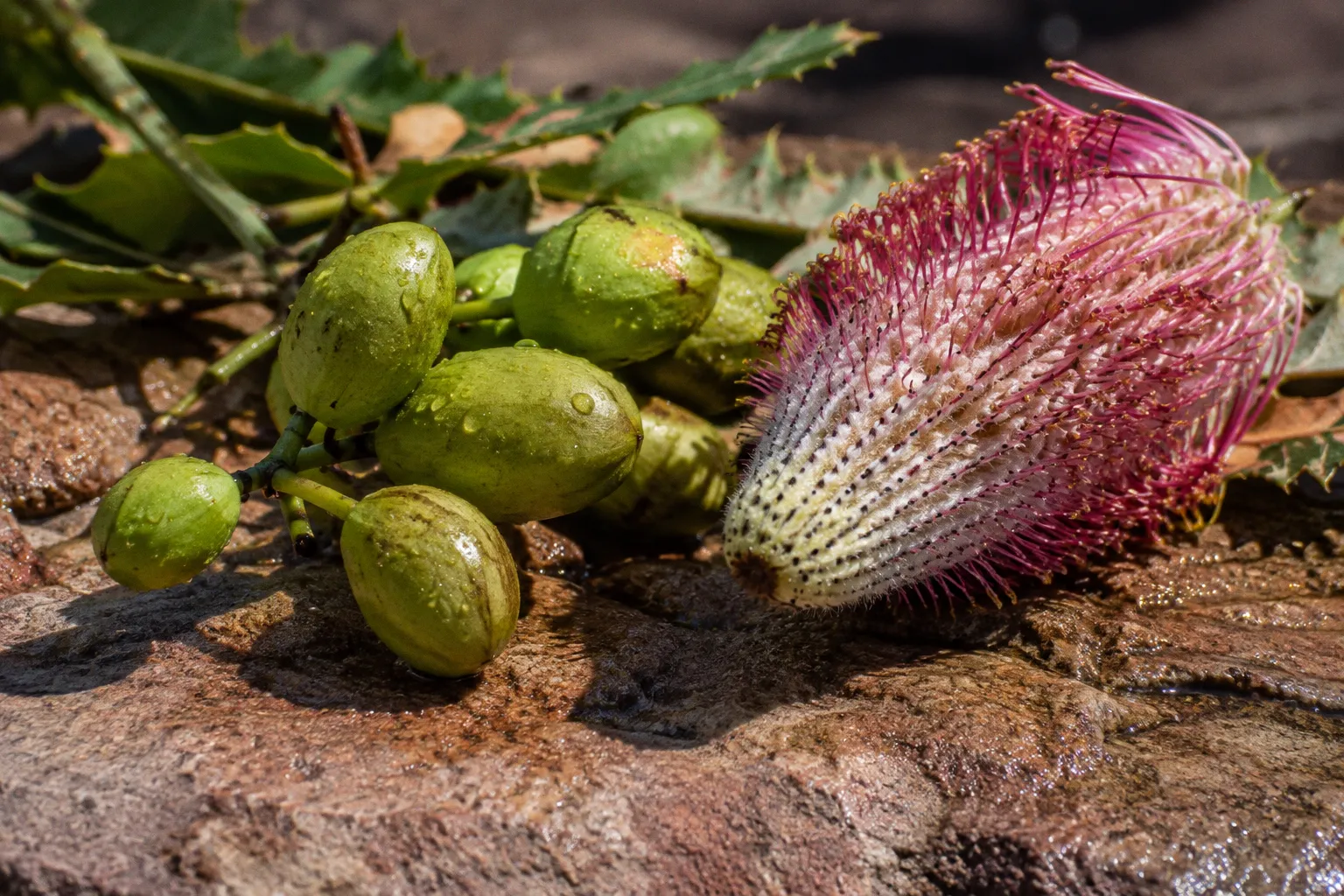
Dullness is rarely just surface fatigue. Beneath the loss of luminosity lies a slower process: oxidative stress accumulating in the epidermis and dermis, free radicals disrupting collagen cross-linking, lipid peroxidation roughening the skin's reflective surface. The botanical answer to that cascade is not folklore or marketing poetry. It is a measured concentration of ascorbic acid locked inside a fruit that grew without irrigation, without synthetic fertilizer, and without a single intervention from human hands. Kakadu plum (Terminalia ferdinandiana) carries between 2,300 and 5,300 milligrams of natural vitamin C per 100 grams of fresh fruit. An orange delivers roughly 50 milligrams per 100 grams. Acerola cherry, long treated as the gold standard of botanical vitamin C, sits around 1,677 milligrams per 100 grams. That gap is not invented; it is a survival strategy written into the plant's phytochemistry, and it is the reason wildcrafted Australian botanicals have moved from the periphery of clean beauty into the formulary of every serious skincare house that works with native flora.
The Science of Survival: Why Wildcrafted Plants Pack More Punch
Australian bushland is not gentle terrain. Soils run lean, rainfall arrives in violent pulses or not at all, and temperatures swing between extremes that would collapse most cultivated crops. Native flora adapted to this volatility by producing dense secondary metabolites — the bioactive compounds that defend plant tissue against UV radiation, pathogen pressure, drought, and flood. Those same compounds translate directly to skin biology. Phenolic acids scavenge free radicals. Flavonoids buffer the inflammatory cascades that follow UV exposure. Tannins tighten and astringe. Polysaccharides hold water against transepidermal loss.
When a plant is wildcrafted, it is gathered from its native habitat in its unmanaged state. No irrigation. No synthetic pesticide. No nitrogen boost from a controlled fertilizer schedule. The plant defends itself the way it has defended itself for millennia, and that defense reads in the laboratory as elevated antioxidant capacity. The molecules responsible are the same as those found in cultivated specimens. The concentration differs because the stressor differs. A Kakadu plum tree standing alone in the Kimberley responds to eight months of dry heat by stacking its fruit with ascorbic acid. A cultivated tree receiving consistent water and shade produces fruit that is still rich, but biologically less armored.
This is where the extraction method begins to matter — and where the chemistry of the carrier decides which part of the plant's chemistry actually reaches the skin. Most Kakadu plum extracts used in skincare are produced through maceration: the fruit is steeped in a carrier oil or solvent, and the soluble compounds migrate into the liquid over hours or days. The choice of carrier determines which fraction of the plant's bioactives ends up in the final bottle. Squalane is a nonpolar lipid, and nonpolar solvents pull out lipophilic compounds — tocopherols, certain flavonoids, and some of the lower-polarity phenolic fractions — while leaving water-soluble molecules like ascorbic acid largely behind. A water-based extract captures a different profile: ascorbic acid dissolves readily, polysaccharides come through, and the polar phenolic acids such as gallic acid concentrate in the aqueous phase. Gallic acid, for instance, is moderately water-soluble rather than strictly lipophilic, so its presence in any given extract depends on the polarity of the solvent chosen, not on the raw fruit alone.
What this means in practice is that no single maceration captures the full phytochemical breadth of Kakadu plum. Formulators who want to deliver both ascorbic acid and the phenolic cofactors that complement it — gallic acid, ellagic acid, and the smaller hydroxybenzoic acids — typically work with dual-extraction approaches: an aqueous or polar co-solvent extract paired with a lipid-phase fraction, or a standardized dry extract that preserves the water-soluble vitamins before incorporation into an oil-based serum. The result can still be delivered in a squalane or jojoba base, but the ascorbic acid enters that base through a separate extraction pathway, not through the nonpolar maceration itself. The distinction matters because it determines how much of Kakadu plum's documented vitamin C content actually survives the journey from fruit to formulation.
Wild plants do not choose to be potent. They are potent because their environment leaves them no alternative.
Certified organic cultivation can be rigorous, but it is still cultivation. The farmer still selects the soil, the spacing, and the harvest window. Wildcrafting removes those variables. What remains is the plant's native phytochemical profile, undistorted by human management — a profile that the lab can read, and that the skin can respond to.
Kakadu Plum and Davidson Plum: Bioactive Concentrations Compared
Kakadu plum is the headline act, but it is not the only native fruit doing meaningful work on the skin's surface. Davidson plum — sometimes referenced in literature alongside Terminalia species, though botanically distinct in its own genus — brings a separate set of bioactives to the formulation table. Its deep purple flesh holds anthocyanin flavonoids, the same pigment family responsible for the antioxidant capacity of blueberries and blackberries, but in a profile shaped by subtropical rainforest pressures. Alongside those pigments sit natural alpha-hydroxy acids — tartaric, malic, citric — that perform gentle exfoliation, encourage cell turnover, and support elasticity by inhibiting the matrix metalloproteinase activity that breaks down dermal collagen under UV stress.
The two fruits are not competitors. They are collaborators. Kakadu plum delivers ascorbic acid at concentrations no cultivated fruit can match, while Davidson plum contributes pigment-derived antioxidants and mild keratolytic action. A formulation that draws on both is building a defense against oxidative stress from two biochemical angles simultaneously.
| Parameter | Kakadu plum | Davidson plum |
|---|---|---|
| Primary bioactive | Ascorbic acid (vitamin C) | Anthocyanin flavonoids |
| Recorded concentration | 2,300–5,300 mg per 100 g fresh fruit | Variable; rich in cyanidin-based pigments |
| Secondary actives | Gallic acid, ellagic acid, related phenolic acids | Natural AHAs (tartaric, malic, citric) |
| Functional role | Antioxidant, brightening, collagen cofactor | Gentle exfoliation, free radical buffering, elasticity support |
| Native habitat | Northern Australia — Kimberley, Top End, Arnhem Land | Eastern Australian subtropical and temperate rainforest |
| Harvest status | Predominantly wild-harvested; limited orchard production | Predominantly wild-harvested; emerging small-scale cultivation |
The numbers in that table are not aspirational. The Kakadu plum vitamin C figures come from published phytochemical surveys of wild-harvested fruit, where concentration varies by season, soil, and rainfall year. The Davidson plum anthocyanin profile has been documented across Australian research groups working with native tropical and subtropical species. Both fruits are still gathered predominantly from the wild, which is part of the broader question this article is built to answer.
Wildcrafting vs Certified Organic: Navigating the Labeling Gap
Here is where the conversation becomes less romantic and more practical. The word organic carries a regulated definition in most markets — in Australia through the Australian Certified Organic standard, in the United States through USDA Organic, in Europe through COSMOS. Each certification body audits the farm, traces the inputs, and verifies that synthetic pesticides, herbicides, and genetically modified organisms have been excluded from the cultivation cycle. The word wildcrafted carries no equivalent legal standing. It describes a harvesting method — plants gathered from their native unmanaged habitat — but it is not, by itself, a guarantee of sustainability, traceability, or chemical purity in the way certified organic is.
This is not a criticism of the practice. It is a clarification that any reader should hold clearly in mind. A wildcrafted extract can be extraordinary in potency and ethically sourced. The same is true of a certified organic extract. The two labels speak to different points in the supply chain, and reading them as interchangeable obscures the actual choices being made.
A few practical distinctions help:
- Wildcrafted plants are foraged from ecosystems that are not managed for yield. The harvest is bounded by what the land can spare without disrupting regeneration, which means supply is inherently limited and seasonal.
- Certified organic ingredients are grown under defined conditions with documented inputs. Yield is more predictable, batch-to-batch consistency is tighter, and regulatory oversight is clearer.
- Wildcrafted and certified organic are not mutually exclusive. Some harvesters pursue dual paths — wildcrafting rare species while cultivating more abundant ones under organic certification to relieve pressure on wild populations.
The label on the jar tells you how the plant was grown. The supplier tells you whether it was grown responsibly.
For readers who want to verify the sourcing of a wildcrafted product, the practical question is not whether the label says organic. It is whether the brand can name the harvest region, the foraging cooperative, and the seasonal window. Transparency at that level is a stronger signal than any single certification badge.
It is also worth noting what wildcrafting does not claim. A wildcrafted botanical is not automatically less allergenic than a synthetic ingredient. Plant material contains natural allergens, natural fragrances, and natural variability in compound concentration. Skin that reacts to a wildcrafted extract is reacting to genuine biochemistry, not to a marketing category. The term carries a sourcing promise, not a safety promise.
Sustainability and the Ethics of Foraging Australian Flora
Potency without sustainability is a short-term advantage. The same ecosystems that produce dense phytochemistry in native plants are also among the most fragile in the Australian landscape. Bushfire recovery cycles run for decades. Rainforest margins retreat under sustained harvest pressure. Indigenous communities hold traditional knowledge of harvest timing, plant selection, and regeneration protocols that predate any contemporary skincare brand by thousands of years.
Ethical wildcrafting, at its best, looks like this: a small number of harvesters enter a known area at a known time of year, take a fraction of the available fruit or foliage, leave the rest for wildlife and regrowth, and return the following season only when the population has recovered. Several Australian botanical suppliers operate under versions of this model, often in partnership with Aboriginal-owned enterprises or land councils that hold cultural authority over specific plant species. Those partnerships are not branding accessories. They are the operational backbone of any harvest that aims to persist beyond a single season.
The pitfalls are equally clear. Overharvesting Kakadu plum in a drought year can deplete a stand that took decades to establish. Demand from international skincare markets — particularly the vitamin C segment, which has grown sharply since botanical ascorbic acid formulations entered the mainstream — places pressure on wild populations faster than they can recover. Publicly available data on standardized international harvest quotas for wild Kakadu plum is limited, and supply chain visibility varies from one supplier to another. Some harvesters publish their annual tonnage and the regions they source from; others disclose little beyond the ingredient name on the label. A consumer who buys a serum containing wildcrafted Kakadu plum extract is, whether they intend it or not, participating in a harvest decision. The question is whether that decision is being made transparently.
The most ethical wildcrafted product is the one whose harvest you can trace back to a specific region and a specific season.
This is why the sourcing conversation matters more than the label conversation. A brand that publishes its harvest region, its partner cooperatives, and its seasonal windows is doing more for sustainability than a brand that relies on the word wildcrafted alone.
Beyond the Hype: Integrating Native Extracts into Your Routine
Native Australian botanicals earn their place in a routine through mechanism, not mythology. Kakadu plum's ascorbic acid concentration makes it a credible alternative to synthetic vitamin C derivatives in brightening serums, and its phenolic acid cofactors support the broader antioxidant network beyond what isolated ascorbic acid offers. Davidson plum's gentle AHA activity positions it for exfoliating masks and resurfacing toners where barrier comfort is a priority. Tasmanian mountain pepper berry brings polygodial, a compound with documented antimicrobial action that has begun appearing in targeted blemish formulations. Each of these is a working ingredient with a measurable function, and the routine should reflect that.
A practical integration might look like this: a Kakadu plum serum in the morning, layered over a hydrating base and under a barrier-supporting moisturizer, then closed with a TGA-regulated SPF50 or SPF50+ primary sunscreen. Research on botanical vitamin C and polyphenol combinations has noted that plant-derived ascorbic acid formulations show measurable photoprotective synergy when paired with broad-spectrum UV filters, though the filter itself remains the regulated primary defense. Organic moisturizers and botanical serums do not replace TGA-approved primary sunscreens; they support the skin beneath it.
Davidson plum fits well into an evening routine, either in a resurfacing toner or a leave-on mask, where its mild AHA activity can work overnight without competing with morning antioxidant layers. Tasmanian pepper berry extracts slot into blemish-prone routines, usually in a targeted serum format where polygodial's antimicrobial action can be concentrated without overwhelming the barrier.
When evaluating a wildcrafted product, the practical questions are:
- Can the brand name the harvest region and the season of harvest?
- Does the supply shift with seasonal availability, or does the brand offer the same SKU year-round regardless of when the plant was actually foraged?
- Does the formulation pair the native extract with barrier-compatible supporting ingredients rather than stripping agents?
- If the product makes any sun protection claim, is it backed by TGA-regulated SPF50 or SPF50+ testing?
A wildcrafted botanical is worth the premium when those questions have satisfying answers. When the label carries more confidence than the supply chain can support, the premium is paying for a story rather than a result. The Australian bush produces genuinely extraordinary plant chemistry — the science confirms it — but the chemistry only translates to skin when the sourcing is rigorous, the formulation respects the ingredient's native character, and the routine that surrounds it is built on equal care.