Morning vs Evening Skincare: Which Steps Matter Most?
The main problem with a skincare routine is rarely the number of products. It is using the right products at the wrong time.
Leo Ashdown·Updated: September 06, 2026·18 min read
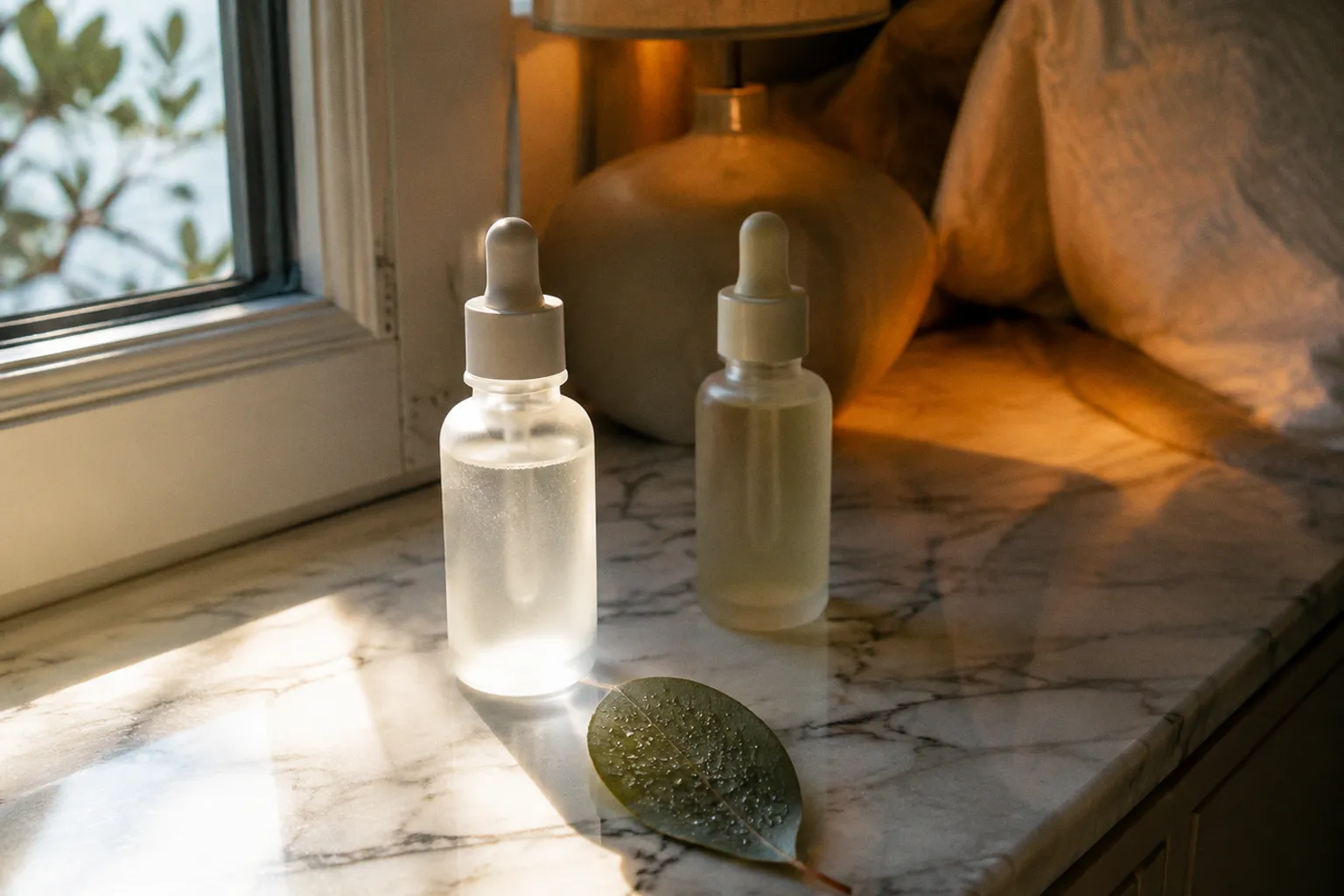
A brightening serum designed for daytime defense may sit under sunscreen in the morning, while a retinoid or exfoliating acid belongs in an evening routine where the skin is no longer exposed to direct UV radiation.
The practical difference between a morning vs evening skincare routine is this: daytime care helps the skin defend itself; nighttime care helps it recover, retain water, and tolerate targeted treatments. Once that division is clear, the routine becomes shorter, more deliberate, and easier to maintain.
The circadian rhythm: why skin needs different care by day and night
Skin does not behave identically across a 24-hour cycle. Its hydration, barrier integrity, sebum production, and repair activity shift with the body’s circadian rhythm.
During the day, the skin is exposed to ultraviolet radiation, pollution, temperature changes, wind, and free radicals. It is operating in a defensive state. The morning routine should therefore create a stable surface: remove overnight residue without stripping the barrier, add water and antioxidants, then finish with broad-spectrum sunscreen.
At night, the priorities change. The skin becomes more permeable, transepidermal water loss increases, and repair processes accelerate. Cell turnover and repair activity peak overnight, particularly between 11 PM and 4 AM. That does not mean a cream applied at 11:01 PM suddenly becomes more effective. It means the evening is the logical window for cleansing thoroughly, applying targeted treatments, and sealing in hydration.
The most useful way to understand morning versus evening skincare routines is to assign each phase a job:
| Routine phase | Primary job | Products that support it |
|---|---|---|
| Morning | Defend against UV exposure, pollution, and oxidative stress | Gentle cleanser, antioxidant serum, hydrating layer, moisturiser, broad-spectrum SPF |
| Evening | Remove accumulated residue, support repair, and reduce moisture loss | Cleanser or double cleanse, treatment serum, barrier moisturiser, facial oil if needed |
| Transition between phases | Keep the barrier stable and prevent unnecessary irritation | Fewer actives, controlled exfoliation, consistent hydration |
A routine does not need to be complicated to reflect these biological differences. It needs to be sequenced correctly.
Daytime skincare is your protective layer. Nighttime skincare is where you do the repair work.
This distinction also explains why copying someone else’s full product lineup often fails. A formula that performs well in an evening routine may be too occlusive for the morning, while a lightweight morning serum may not provide enough barrier support overnight.
The morning defense: the AM steps that matter most
Morning skincare should be calm, light, and protective. The goal is not to make the skin feel aggressively clean or overloaded with actives before leaving the house. The goal is to begin the day with a hydrated barrier and enough protection to manage environmental stress.
1. Cleanse without disturbing the barrier
Whether you need a full cleanser in the morning depends on what happened overnight and how your skin behaves. If you applied a rich facial oil or occlusive balm the previous evening, a gentle cleanse may be useful. If your skin is dry, reactive, or tight when you wake, rinsing with lukewarm water or using a low-foaming cleanser may be enough.
Avoid using the morning cleanse to compensate for oiliness with harsh surfactants. The immediate sensation of squeaky skin is not proof that the barrier is clean; it can indicate that surface lipids have been removed too aggressively. Once the barrier is compromised, the skin may feel drier, sting when products are applied, or become more reactive to otherwise familiar ingredients.
For an organic morning and evening skincare regimen, look for a cleanser that removes sweat and residue without relying on a strong fragrance load or a stripping finish. Botanical ingredients can be useful, but the formula’s total behaviour matters more than the presence of a particular plant extract.
Use:
- Lukewarm water rather than hot water.
- A small amount of cleanser, spread over damp skin.
- Minimal rubbing, especially around the nose and cheeks.
- A clean towel pressed against the skin instead of dragging it across the face.
2. Add water before adding richness
Hydration is not the same as oil. A facial mist, essence, or watery serum can add a layer of water and humectants, while a moisturiser or facial oil helps slow its evaporation.
This is where a calming facial toning mist routine can be useful. Apply the mist to freshly cleansed skin, then follow promptly with a serum or moisturiser. Leaving a watery layer to evaporate completely in a dry environment can leave the skin feeling tighter, particularly if the formula contains humectants without enough emollient support.
A mist is not a replacement for moisturiser. Treat it as a preparation step:
1. Cleanse or rinse.
2. Apply the mist while the skin is still slightly damp.
3. Layer a hydrating serum if needed.
4. Apply moisturiser to reduce water loss.
5. Finish with sunscreen.
If your skin is oily but dehydrated, this sequence is often more useful than applying a heavy cream immediately. It gives the skin water first, then allows you to control the amount of occlusion.
3. Use antioxidants as support, not as a reason to over-layer
Vitamin C and other antioxidant ingredients are commonly placed in the morning because they complement daytime protection. They help support the skin against oxidative stress, but they do not replace sunscreen.
The formula and your tolerance determine how often to use an antioxidant serum. A strong product that causes persistent stinging is not a successful product simply because it is technically active. Buffer it with a moisturiser, reduce the frequency, or move to a gentler formulation.
A practical morning sequence looks like this:
- Hydrating mist or essence.
- Antioxidant serum.
- Moisturiser.
- Broad-spectrum sunscreen with SPF 30 or higher.
If you use several serums, pause and ask whether each one has a distinct role. Layering an antioxidant, a brightening serum, a peptide serum, and multiple botanical concentrates can create a crowded routine without improving the outcome. More layers also increase the chance of pilling beneath sunscreen.
4. Treat sunscreen as the final morning step
Broad-spectrum sunscreen is the non-negotiable difference between a protective morning routine and a merely hydrating one. SPF 30 or higher is the baseline commonly recommended for daily protection; SPF 50 or higher is a reasonable choice when UV exposure is high, you spend significant time outdoors, or your skin is prone to pigmentation.
Apply sunscreen after moisturiser and allow the previous layers to settle enough to form an even film. If the sunscreen pills, do not immediately add more products. Reduce the number of layers underneath, allow more drying time, or change the texture of the serum or moisturiser.
Organic skincare products can fit into an effective morning routine, but “organic” does not remove the need for UV protection. Botanical oils, herbal extracts, and mineral-rich formulas may support comfort and nourishment; none should be treated as a substitute for a tested broad-spectrum sunscreen.
The order is simple:
- Thin, watery products first.
- Creamier hydration next.
- Facial oil only if your skin needs additional emollient support.
- Sunscreen last.
Oil beneath sunscreen can be appropriate for very dry skin, but use a small amount. Too much oil may interfere with the uniform sunscreen film or make the skin feel heavy during the day.
The nighttime shift: cleansing, treatment, and repair
The evening routine carries more of the corrective work because it is the point at which sunscreen, makeup, sebum, pollution, and accumulated residue need to come off. It is also the phase where many people introduce too many actives at once.
Nighttime skincare is not an invitation to exfoliate every evening. It is a chance to create the conditions in which the barrier can recover and targeted ingredients can be used consistently.
1. Remove sunscreen and makeup thoroughly
If you have worn sunscreen or makeup, begin with a first cleansing step that can dissolve the products sitting on the surface. This may be a cleansing oil, balm, or milk, followed by a water-based cleanser. The exact format matters less than whether the skin feels clean without feeling stripped.
Double cleansing is useful when there is a substantial first layer to remove. It is not automatically necessary every night for every person. If you have not worn sunscreen or makeup and your cleanser removes the day’s residue comfortably, adding another cleansing step may create unnecessary friction.
A thorough evening cleanse should leave the skin:
- Free of visible sunscreen or makeup residue.
- Comfortable rather than tight.
- Smooth enough for the next product to spread without aggressive rubbing.
- Calm around the eyes, nose, and mouth.
If your face feels unusually dry after cleansing, adjust the cleanser before adding more moisturiser. A richer night cream cannot fully compensate for a cleansing step that repeatedly disrupts the barrier.
2. Choose one main treatment direction
The evening is the usual home for retinoids and exfoliating acids because some active ingredients can increase sensitivity to sunlight, and because the skin’s nighttime permeability makes the phase suitable for treatment and replenishment. Do not treat that as permission to combine every active in the cabinet.
Choose the problem you are addressing:
- Uneven texture may respond to a carefully scheduled exfoliating step.
- Signs of congestion may require a targeted acne treatment.
- Dullness may benefit from a gentle enzyme exfoliation routine used intermittently.
- Dryness and sensitivity require barrier support before stronger correction.
- Early signs of irritation require a pause from exfoliating acids and retinoids.
A simple skin cycling protocol can reduce the impulse to use an active every night. One evening may be dedicated to a retinoid, another to exfoliation, and the remaining nights to hydration and barrier recovery. The exact schedule should follow your skin’s tolerance, not a rigid calendar.
Do not apply a retinoid or strong exfoliant in the morning simply to make the routine symmetrical. These ingredients belong in a carefully managed evening regimen, followed by diligent daytime sunscreen.
For sensitive skin, buffer the active:
1. Cleanse and allow the skin to dry.
2. Apply a light moisturiser if direct application causes irritation.
3. Use a small amount of the treatment.
4. Finish with another thin layer of moisturiser if needed.
This sandwich method is not a failure of the active. It is a way to reduce irritation and improve consistency.
3. Restore the barrier before adding more correction
Nighttime is when the skin’s repair activity increases, but transepidermal water loss also rises. The skin can lose more water while it is becoming more permeable to active ingredients. That is why a night routine that contains only acids, retinoids, or lightweight serums often leaves the face tight by morning.
A barrier-focused evening routine should include some combination of:
- Humectants that draw water into the outer layers.
- Emollients that soften rough areas and fill gaps between skin cells.
- Occlusives that slow water loss.
- Soothing ingredients selected for tolerance rather than trend value.
Apply these from lighter to richer textures. A hydrating serum can go first, followed by a moisturiser. If your skin remains dry, add a small amount of facial oil over the moisturiser.
A nourishing facial oil layering routine works best when the oil is used to support an existing moisturising step, not when it is expected to supply all hydration by itself. Oil reduces water loss; it does not provide the same function as a water-based hydrating product.
For dry or sensitised skin, the evening order may be:
- Gentle cleanser.
- Hydrating mist or serum.
- Barrier moisturiser.
- One or two drops of facial oil pressed over the driest areas.
Occlusion should be selective. Applying a heavy layer across the entire face may feel comforting but can be counterproductive if you are prone to congestion. Start with the cheeks, around the mouth, or other areas that show flaking, and leave oilier zones lighter.
Transepidermal water loss changes the AM versus PM strategy
Transepidermal water loss, usually shortened to TEWL, describes the movement of water from the skin through the epidermis and into the surrounding air. It is a useful concept because it explains why a product can feel hydrating for ten minutes and still leave the skin dry later.
At night, increased TEWL makes the final moisturising step especially important. The objective is not to seal the face under the heaviest possible product. It is to match the level of barrier support to the skin’s actual needs.
If the skin feels tight after cleansing
Use a less aggressive cleanser, reduce water temperature, and apply moisturiser while the skin is still slightly damp. Do not respond by immediately adding multiple oils and balms. First remove the source of the tightness.
If the skin is shiny but dehydrated
Use thinner hydrating layers and a light moisturiser rather than skipping moisturiser altogether. Surface oil does not guarantee adequate water content. A dehydrated, over-cleansed barrier can produce both tightness and excess shine.
If the skin stings when applying familiar products
Pause exfoliating acids, retinoids, fragranced products, and strong antioxidant formulas. Return to cleansing, hydration, moisturiser, and sunscreen. Once the skin is comfortable again, reintroduce one active at a time.
If the face is flaky in the morning
Do not automatically exfoliate the flakes away. Flaking can indicate irritation or a weakened barrier, not simply excess dead skin. Use a richer moisturiser at night, reduce active frequency, and allow the surface to stabilise.
When the barrier is unstable, the correct treatment is often subtraction: fewer actives, less friction, and more controlled occlusion.
The difference between a healthy glow and a temporarily polished appearance is usually barrier stability. A glow that depends on constant exfoliation will not remain comfortable for long.
Layering logic: from thinnest to thickest
Product order is not a ritual rule for its own sake. It affects how evenly each layer spreads, how much rubbing is required, and whether the final sunscreen or moisturiser forms a uniform film.
The general sequence is:
1. Cleanser.
2. Watery mist, toner, or essence.
3. Lightweight treatment serum.
4. Cream-based treatment, if used.
5. Moisturiser.
6. Facial oil.
7. Sunscreen in the morning.
Not every routine needs every step. If your cleanser is followed by a moisturiser and sunscreen in the morning, that is a complete routine. If your evening routine requires only a cleanser, treatment, and barrier cream, adding a mist and two serums is optional rather than essential.
Why texture matters
Thin products spread most evenly when they are applied before heavier products. A thick balm applied first can reduce the even distribution of a watery serum placed over it. It can also make the skin difficult to assess: you may mistake surface slip for genuine hydration.
The exception is intentional buffering. If you apply moisturiser before a retinoid to reduce irritation, you are changing the sequence for a specific reason. That is not an error; it is a controlled adjustment.
How long should you wait between layers?
You do not need to measure a fixed number of minutes between every product. Apply the next layer once the previous one has spread evenly and is no longer moving excessively across the surface.
For morning sunscreen, allow enough time for the moisturiser to settle so the sunscreen can form a continuous film. If the routine pills, shorten it before assuming the products are incompatible. Too much product, excessive rubbing, and incompatible textures are common causes.
Where facial oil belongs
Facial oil usually belongs after moisturiser because it helps reduce water loss from the layers beneath. It can also be mixed into moisturiser if that improves spreadability, but do not assume more oil means more nourishment.
Use less than you think you need:
- One or two drops for combination or mildly dry skin.
- A few drops for very dry areas, applied selectively.
- No oil over congested zones if it consistently increases heaviness or breakouts.
The best organic morning and evening skincare regimen is not the one with the most botanical ingredients. It is the one you can apply in the correct order without irritation, pilling, or constant experimentation.
Morning vs evening skincare routine differences in practice
The AM and PM routines should work together rather than compete. A strong morning routine cannot repair the effects of harsh cleansing at night, and an elaborate evening regimen cannot compensate for skipping sunscreen during the day.
Here is a practical comparison:
| Step | Morning | Evening |
|---|---|---|
| Cleansing | Gentle cleanse or rinse, depending on residue and skin type | Thorough cleanse; double cleanse when removing sunscreen or makeup |
| Hydration | Mist, essence, or serum to prepare the skin for daytime layers | Hydrating layer to reduce the impact of overnight water loss |
| Antioxidants | Useful support against daytime oxidative stress | Optional; not necessary if the evening already contains several actives |
| Retinoids | Generally not the preferred phase because of sun exposure concerns | Usually reserved for the evening and introduced gradually |
| Exfoliation | Usually avoid strong acids before daytime UV exposure | Schedule intermittently and avoid combining with every other active |
| Moisturiser | Lightweight or medium texture beneath sunscreen | Richer barrier support may be appropriate |
| Facial oil | Optional, used sparingly to avoid interfering with sunscreen | More useful as a final emollient or occlusive layer |
| Sunscreen | Broad-spectrum SPF 30 or higher as the final step | Not needed as a nighttime layer |
This division gives you a clear default without pretending that every skin type needs the same product intensity. A person with oily, acne-prone skin may need a gel moisturiser at night. A person with a damaged barrier may need a richer cream in both phases. A person with resilient skin may tolerate more frequent treatments, while someone sensitive may need several recovery nights between them.
A streamlined AM/PM routine for different barrier states
For balanced skin
Morning
- Gentle cleanse or rinse.
- Hydrating mist or serum.
- Antioxidant serum if tolerated.
- Lightweight moisturiser.
- Broad-spectrum SPF 30 or higher.
Evening
- Cleanse thoroughly.
- Use one targeted treatment on scheduled nights.
- Apply moisturiser.
- Add facial oil only to dry areas.
For sensitive or barrier-impaired skin
Morning
- Rinse or use a non-stripping cleanser.
- Apply a calming hydrating layer.
- Use a fragrance-free barrier moisturiser.
- Finish with sunscreen.
Evening
- Cleanse gently, without repeated washing.
- Apply a simple hydrating serum or mist.
- Use a richer barrier cream.
- Occlude dry areas selectively if needed.
Put retinoids, exfoliating acids, essential-oil-heavy products, and strong vitamin C formulas on hold until the skin no longer stings or flakes. Reintroduce only one variable at a time.
For congested or acne-prone skin
Morning
- Gentle cleanser.
- Lightweight hydrating serum.
- Non-heavy moisturiser.
- Broad-spectrum sunscreen.
Evening
- Remove sunscreen and makeup thoroughly.
- Use one acne-focused treatment according to tolerance.
- Apply a non-comedogenic moisturiser.
- Avoid layering several drying treatments over the same areas.
Congestion is not always a sign that the skin needs more exfoliation. Repeated stripping can worsen discomfort and make the routine harder to sustain. Keep the treatment targeted and the barrier supported.
For dry skin
Morning
- Minimal cleanse.
- Hydrating mist or serum.
- Cream moisturiser.
- Sunscreen.
- Facial oil only if it does not compromise the sunscreen layer.
Evening
- Gentle cleansing balm or milk.
- Hydrating serum.
- Rich barrier cream.
- A small amount of facial oil pressed over the driest areas.
Dry skin benefits from consistency more than from constant product rotation. Let each change settle before deciding that the routine has failed.
Troubleshooting the routine when results stall
A routine can be logically structured and still need adjustment. Troubleshoot in sequence rather than replacing every product at once.
The skin is dull despite multiple serums
Check the basics first: cleansing, hydration, moisturiser, and daily sunscreen. Dullness can come from dehydration or irritation, not only from slow exfoliation. Reduce the number of active layers and assess whether the skin feels smoother and more comfortable.
The skin looks brighter but feels thinner or more reactive
This usually suggests that exfoliation is outpacing barrier recovery. Reduce acid or enzyme frequency, stop combining several exfoliants, and add richer evening support. A gentle enzyme exfoliation routine should leave the skin comfortable after use, not tight and glossy.
Products pill in the morning
Reduce the number of layers, use less product, and avoid rubbing once the serum begins to set. Check whether facial oil is being applied underneath sunscreen. In many routines, oil works better at night or only on dry patches.
The skin is oily by midday
Do not assume that aggressive cleansing is the answer. Use a lighter moisturiser, keep the hydrating layers thin, and observe whether the skin is simultaneously tight or flaky. If it is, the routine may be over-cleansing while under-supporting the barrier.
The skin becomes irritated after adding a new active
Return to the last routine that felt stable. Once the skin settles, reintroduce the new product alone, at a lower frequency. Avoid changing cleanser, serum, exfoliant, and moisturiser in the same week; otherwise, you lose the ability to identify the trigger.
The practical answer: both phases matter, but they do different work
There is no single winner in the morning versus evening skincare comparison. The morning routine protects the progress made overnight; the evening routine prepares the skin to recover and receive treatment without unnecessary stress.
If you need to reduce your routine to essentials, keep:
Morning: gentle cleansing, hydration, moisturiser if needed, and broad-spectrum sunscreen.
Evening: thorough cleansing, one appropriate treatment if tolerated, and barrier-supportive moisturiser.
Everything else should earn its place by improving comfort, consistency, or a specific skin concern. Build the routine around the skin’s daily demands, layer from thin to thick, buffer strong actives when necessary, and treat barrier protection as the organising principle rather than the final emergency step. That is how an AM vs PM skincare routine becomes practical: not two competing rituals, but two phases working toward the same stable, healthy skin.